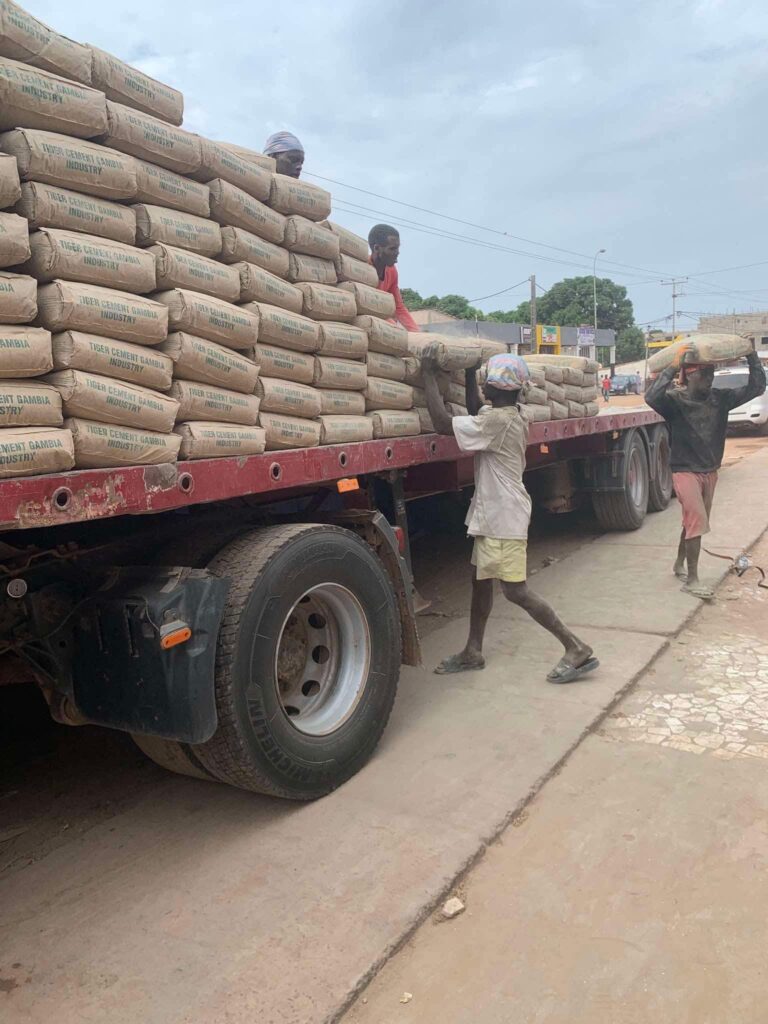
Cement prices across parts of The Gambia remain higher than expected, despite recent government measures aimed at easing costs and increasing supply.
Last week, the government removed a D180 tax levy on each bag of cement imported by land from Senegal, following public concern over rising prices and their impact on construction activity.
The move was accompanied by assurances from local importers, including Tali Logistics, that increased imports would help stabilise the market and lead to lower prices.
However, checks across several communities suggest that prices have yet to fall to the levels previously indicated.
In areas including Old Yundum, Busumbala and Brikama, imported Senegalese cement was being sold this week at prices ranging between D550 and D600 per bag, several days after land imports resumed.
Cement supplied by Jah Oil Company was also found to be selling above factory or outlet prices at some retail points.
The company has previously stated that it supplies cement to retailers at D390 per bag and sells at D450 at its own outlets, while urging retailers to adhere to recommended prices.
At several retail locations, customers reported difficulty obtaining receipts or invoices for purchases, a situation that some buyers said added to uncertainty around pricing.
Many customers expressed disappointment that prices have not reduced as quickly as anticipated, saying the continued high costs have affected construction timelines and budgets.
Responding to the concerns, an executive of Tali Logistics, Momodou Jobe, said the company began importing cement by land from Senegal on 13 December.
He said Tali Logistics has set internal price guidelines of D460 per bag in the Greater Banjul Area and D445 in other regions, noting that earlier expectations of a D420 price had not materialised due to additional costs, including taxation and transportation.
Mr Jobe added that the company is working to increase supply in order to support price stability, with plans to bring in larger volumes of cement in the coming days.
On the issue of oversight, the Gambia Competition and Consumer Protection Commission said its role is largely guided by consumer feedback.
Musa Darboe, Human Resources Manager at the Commission, said the body relies on formal complaints from consumers to engage on pricing concerns, adding that ongoing discussions aim to strengthen the commission’s capacity to respond more effectively in future.
For now, consumers and traders alike say they are watching closely to see whether increased supply will translate into lower prices in the weeks ahead.
By Adama Makasuba





Recent Comments