
Sixty‑one years after independence, The Gambia stands at a defining crossroads, a moment that demands sober reflection on who we are, how far we have come, and what remains unfinished.
Ours is a nation that has defied the predictions of scholars, survived the weight of authoritarianism, and endured the skepticism of the world.
Yet it is also a nation still wrestling with the structural weaknesses that Berkeley Rice identified in his seminal 1967 work, Enter Gambia: The Birth of an Improbable Nation.
Rice’s assessment was direct. He described The Gambia as geographically narrow, economically fragile, and administratively limited, making its survival seem unlikely.
He noted the country had only one airport, one bank, three high schools, a minimal civil service, and a parliament where literacy was not assured. He concluded The Gambia was “an improbable nation,” perhaps even a “stillborn state.”

Yet, six decades on, this improbable nation yet, six decades later, The Gambia endures. Our democracy remains fragile, still seeking stability. While some view our political continuity—only three presidents in 61 years—as a strength, stability without innovation leads to stagnation.
Unlike nations that renew leadership and vision, we have seen little change. This highlights the distance we still need to travel toward a robust democracy.
In Scottish poet Robert Burns ” A Man’s a Man,” the line rings painfully true: A man can’t ride your back unless it is bent. For too long, Gambians have accepted complacency, fear, and entrenched power. Leaders have overstayed, citizens have demanded too little, and institutions have failed to provide necessary oversight.
The Gambia’s constitutional history mirrors its democratic fragility. Since independence, the country has lived under two colonial constitutions, drafted without Gambian participation.
One military‑inspired constitution, the 1997 charter, was imposed by decree. Sixty‑one years later, The Gambia still lacks a homegrown, people‑centered constitution. The Draft 2020 Constitution, the closest the nation came to a democratic rebirth, was derailed by political self‑interest.

Today, the country continues to operate under a document that neither reflects its aspirations nor safeguards its future.
This constitutional void is not just a symbol; it is the very foundation of our struggles. It allows presidents to overstay, provides fertile ground for corruption, and leaves our institutions fragile.
True independence is not marked by lowering a foreign flag, but by lifting a people’s ability to govern themselves with dignity, justice, and vision. By this standard, The Gambia’s independence is still unfinished business.
The Gambia still boasts just one national university, a glaring sign of how far our education system still has to go. Colonial-era police stations still stand, relics of a state slow to modernize. Corruption festers. Too many Gambians still live in grass houses.
Our youth, hungry for opportunity, continue to leave in search of hope. Politics is shaped more by personalities than by strong institutions.
Rice’s critique still lingers because the cracks he saw have yet to be mended. Yet, this year, hope feels different—more real. A breakthrough marks this Independence Anniversary: for the first time, electricity has reached villages that have known only darkness for generations. This is not just a milestone; it is a leap forward for our civilization.
Electricity means light above one’s head, cold drinking water, the ability to charge a phone, a fan to cool a child at night, and a television that connects a village to the world.
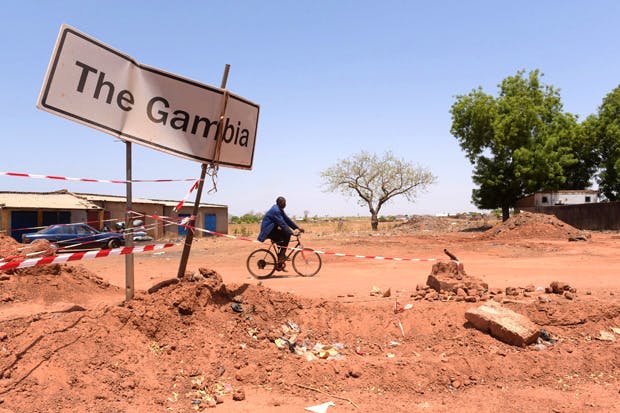
One rural resident captured the significance of this moment with striking clarity:
“I grew up studying under a kerosene lamp. Electricity was a miracle I first saw in Banjul. Today, for the first time, my village has light, and this Ramadan, we will drink cold water. That is what independence feels like.”
This is true independence: not speeches, but transformation. President Adama Barrow deserves recognition for this achievement. Rural electrification is a generational investment that can change a nation’s trajectory and expand the meaning of citizenship.
For the first time, villagers can say, “We are part of the modern world.” Rural electrification connects remote communities, driving social and economic development.
Access to power enables households to use electric lighting, increasing safety and productivity. Villagers in Foni and Niumi now have access to TVs, radios, and smartphones, connecting them to information and education.
It supports local businesses, increases agricultural production, and powers school computer labs and health facilities.
This is the breaking of the yoke of servitude, not through slogans, but through infrastructure. Our independence between improbability and possibility? Berkeley Rice saw The Gambia as an improbable nation. He was not wrong about its weaknesses, but he underestimated its resilience.
Today, the country remains improbable but also undeniably possible. It has survived what should have broken it. It has endured what should have erased it. And now, with rural electrification, it is beginning to transform.
But survival is not enough. The Gambia must now build a nation worthy of its people.
As the nation marks sixty‑one years of independence, it stands at a defining crossroads.
The challenges ahead cannot be resolved by slogans of unity alone. What is required is a genuine and peaceful Gambia, built on harmony, justice, and a collective determination to create a nation that works for all.
The Gambia belongs to all its people, not to any single individual, party, or generation. The hardships faced by youth and women must not be ignored. Their frustrations are real, and if left unaddressed, they may ignite a passionate response that no leader should underestimate. M
This moment calls for leadership that listens, leadership that heals, leadership that builds. It calls for a new constitutional order, a new political culture, and a new commitment to democratic renewal.
As Lyndon Johnson reminded the world,” Yesterday is not ours to recover, but tomorrow is ours to win or lose.” The Gambia must choose to win tomorrow. The energy among Gambians is unmistakable.
Rather than dwelling on past grievances, the nation must look to the horizon with ambition and optimism. It is time to mentor and nurture a new generation of visionaries, young Gambians who can carry the country into a future defined not by improbability, but by purpose and progress. The fruits of transformative leadership are within reach. The spirit of a new Gambia is alive.
Together, the nation can embrace the change it seeks, a united people with a shared dream for a better tomorrow.
By Alagi Yorro Jallow





Recent Comments