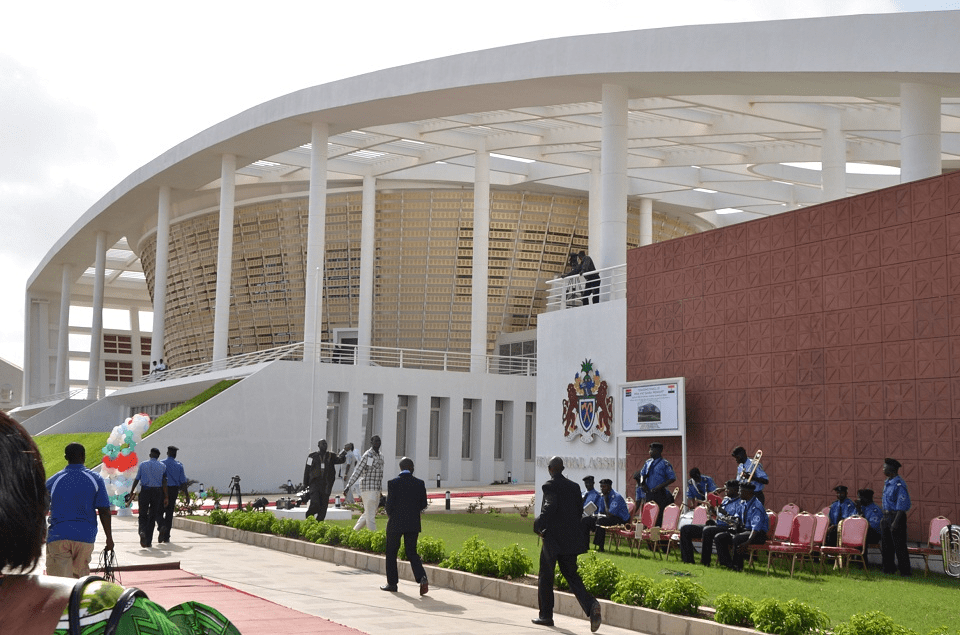
The National Assembly’s Special Select Committee has spoken with a clarity and courage rarely seen in our legislative history. At the very top of its recommendations, placed deliberately, unmistakably, and without diplomatic cushioning, the Committee calls for criminal investigations into Alpha Amadou Barry and Alpha Kapital Advisory for conspiracy to defraud the State, and further insists that Mr. Barry be permanently prohibited from conducting any business with the Government of The Gambia. This is not a minor administrative note. It is a thunderclap. It signals that Parliament is no longer willing to tolerate the culture of impunity that has long shielded politically connected actors from accountability. It is the opening line of a report that exposes not only individual wrongdoing but the structural weaknesses that have allowed corruption to thrive in the shadows of our public institutions.
A nation does not collapse in a single moment. It erodes slowly, through the quiet decay of institutions, the normalization of shortcuts, and the steady corrosion of public trust.

The Committee’s report forces the country to confront this uncomfortable truth. Its findings on the sale and disposal of former President Yahya Jammeh’s assets are not merely a recounting of past failures; they are a mirror held up to the state, reflecting the structural fragilities that continue to haunt our public administration nearly a decade after the fall of the dictatorship.
The Committee found that the disposal of Jammeh’s assets was not conducted within any coherent, disciplined, or accountable system of public asset governance. What emerged was not a series of isolated mistakes, but a pattern of institutional fragility: fragmented custodial arrangements, inconsistent enforcement of court orders, defective valuation processes, incomplete reconciliation of proceeds, and blurred lines of responsibility across ministries and agencies.
These are not the symptoms of a healthy state. They are the fingerprints of a system still struggling to free itself from the past’s administrative culture.
The failures were not incidental. They were structural. They reveal that while legislative reforms were undertaken after 2016, the deeper systems that enable transparency and accountability were only partially reformed. The laws changed, but the habits did not.
Informal decision‑making practices persisted. Documentation standards remained weak. Technical capacity in key portfolios was insufficient. Professional orientation was inconsistent. The problem, therefore, is not merely legal; it is cultural. It is the culture of governance itself.
This is why the Committee’s report is not simply retrospective. It is diagnostic. It demonstrates that asset recovery does not end with freezing orders, commissions of inquiry, or White Papers. It ends with transparent, disciplined, and accountable disposal, the very stage where the system collapsed.

Without a structured post‑forfeiture regime anchored in strict financial controls, traceable procedures, competent oversight, and real‑time reconciliation of proceeds, the objective of safeguarding public resources is undermined at the final and most critical stage.
The Committee’s recommendations reflect the seriousness of these findings. It calls for criminal investigations into Mr. Barry and Alpha Kapital Advisory. The Committee urges the Executive to investigate whether Mr. Barry’s appointment by former Attorney General Abubacarr Tambadou involved corrupt practices. It also recommends disciplinary action against the former Secretary to the Cabinet for permitting unsigned reports to be presented to the Cabinet.
The Committee demands that all Cabinet conclusions on the Janneh Commission be submitted to the National Assembly within thirty days. These recommendations are not symbolic. They are a constitutional challenge to the Executive and a test of political will. They demand accountability in a country where impunity has often been governance’s default setting.
The National Assembly has done its part with rare courage in our legislative history. It confronted the Executive fearlessly, exposed the system’s weaknesses with forensic precision, and placed the burden of action squarely on the President’s shoulders.
The question now is whether President Adama Barrow will act. This is not merely a legal, political, or moral question; it will define his legacy. Some observers argue that if President Barrow fully implements the Committee’s recommendations, it could be one of the most decisive moments of his presidency.
They note corruption is no longer just a governance issue; it is now a social and political demand. Gambians lare tired of selective justice, of watching the powerful escape accountability while the powerless face the full weight of the law, and of impunity masquerading as stability.
In this context, decisive action on the Committee’s recommendations could reshape the political landscape before 2026. It would show the President is ready to confront corruption in action, not just words. It could signal a break from the culture of impunity that has long weakened public trust. As some say, this could be a “slam dunk” moment—where public expectation, parliamentary courage, and presidential opportunity fully align.
Beyond political advantage, this is a test of leadership—of whether the Executive will match Parliament’s bravery, and whether justice institutions, the police, the anti-corruption body, and the Director of Public Prosecutions will step up. It is a test of the state’s readiness to address its administrative past.
The Gambia stands at a crossroads. One path leads to accountability, institutional renewal, and the return of public trust. The other leads back to the familiar swamp of impunity. In that place, reports gather dust and recommendations die quietly in the corridors of power.
History has opened the door. Parliament has pushed it wide. Whether President Barrow walks through it will determine not just the future of his administration, but also the future of justice in The Gambia. The nation is watching. The institutions are waiting. History will remember who acted and who hesitated.
By Alagi Yorro Jallow






Recent Comments