In an era where political messaging shapes national temperament, the United Democratic Party must remember that credibility is earned through sacrifice, consistency, and institutional memory, not through post‑2016 reinventions, curated personal branding, or photo‑op politics.
A troubling pattern has taken root in Gambian political life: the rise of the peace‑time hero, the figure who discovers courage only after the dictator has fled, who finds his voice only when the danger has passed, and who now speaks with the authority of those who bore the weight of resistance long before him.
It is within this context that the recent interventions of Mr. Saikou Camara, the current head of communication of the United Democratic Party, must be examined with sobriety and historical clarity.
Mr. Camara is not a name etched into the early chronicles of the UDP. He was not present when the party was founded in defiance of Yahya Jammeh’s authoritarianism. His voice was not among those who resisted when journalists were killed, when media houses were burned, when reporters fled into exile, when the Gambia Press Union stood alone against a state determined to extinguish dissent.
During those years, Mr. Camara was known primarily as a motivational speaker—an honourable craft, but not one associated with the trenches of democratic struggle.
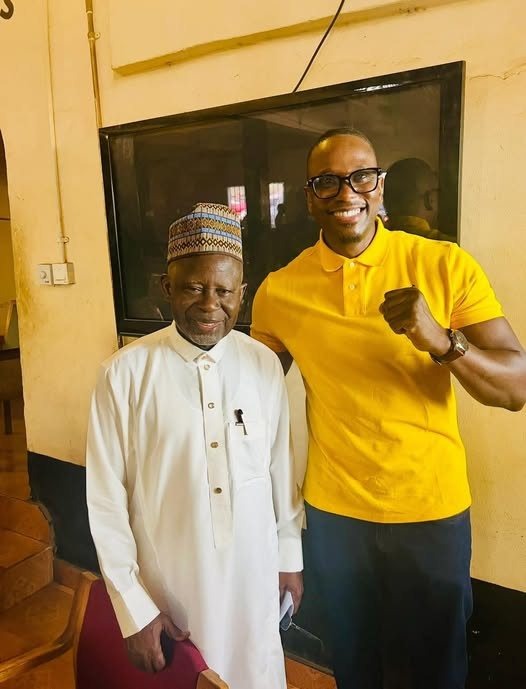
Today, however, he occupies the front seat of the UDP’s communication machinery, issuing pronouncements with the confidence of a seasoned strategist. Yet political communication is not a stage for self‑promotion. It is not the art of curating one’s best photographs, posing beside party leaders, or flooding social media with carefully selected portraits designed to elevate personal image rather than advance party messaging.
Personal branding is not political communication. A gallery of flattering images is not a communication strategy. And proximity to leadership, captured in photos and circulated online, is not a substitute for institutional memory or professional competence.
For decades, the UDP’s public voice was shaped by individuals like Mr. Ebou Manneh, one of the party’s most thoughtful thinkers and a master of political communication. His press releases were models of clarity and professionalism: concise, timely, newsworthy, structured in the inverted pyramid, anchored in the 5Ws, and written in a tone that respected journalists and aided public understanding. His work was not about ego; it was about service. It was about the party, the country, and the democratic project.
By contrast, the communication style now emerging under Mr. Camara is shaped more by social‑media theatrics than by disciplined political messaging. His recent statement, invoking examples from the GPU, GALA, and the GPA Staff Association, attempts to normalize incendiary political language by framing it as mere “figures of speech.”
But this argument collapses under the weight of its own contradictions. The GPU’s resistance was rooted in institutional responsibility. GALA’s activism was grounded in civic mobilisation. The GPA Staff Association spoke within the context of labor advocacy. None of these actors were political parties seeking electoral advantage. None were senior political figures whose words carry national consequence.
Political communication is not motivational speaking. It is not the art of dramatic phrasing. It is the careful stewardship of public temperature. It requires an understanding that language can mobilise as well as inflame; it can inspire as well as divide.
When a senior political figure uses metaphors of sacrifice, blood, or martyrdom, the implications differ from those when a union leader or activist uses them. Context matters. History matters. Responsibility matters.
To accuse others of double standards while ignoring these distinctions is to misunderstand the very foundations of political communication. It is also worth noting that the UDP itself once condemned inflammatory rhetoric from government officials precisely because such language erodes democratic norms, heightens polarization, and undermines public trust.
The UDP deserves better than communication that confuses emotionalism with strategy. The country deserves better than messaging that blurs the line between civic resistance and political brinkmanship.
And the memory of those who stood firm during the Jammeh years deserves better than to be overshadowed by those who discovered their political voices only after the danger had passed.
Political communication is a strategic, high‑pressure, historically grounded profession.
It requires mastery of messaging, crisis management, media relations, and narrative discipline. It requires years of experience, not years of Facebook posts. It requires the humility to learn from those who built the party’s communication architecture long before 2016.
As the Mandinka proverb reminds us: “Kafu le tii la, mansa le tii la”—the crowd has its time, but leadership has its burden. And leadership in communication demands more than visibility; it demands vision, memory, and responsibility.
May our words be seeds of clarity, not sparks of division. May our politics honor those who suffered for our freedoms. And may the Gambia’s democratic journey be guided not by peace‑time heroes, but by those who remember the cost of silence.
By Alagi Yorro Jallow





Recent Comments