
African prison literature, historical memory, and the ethics of comparison show important distinctions: not every detainee is a dissident, and not every note qualifies as literature.
This tradition is grounded in blood, courage, and truth—not mere noise. To compare classic prison writing to a casual note from Kotu Police Station is to diminish true struggle and distort history by blurring these lines.
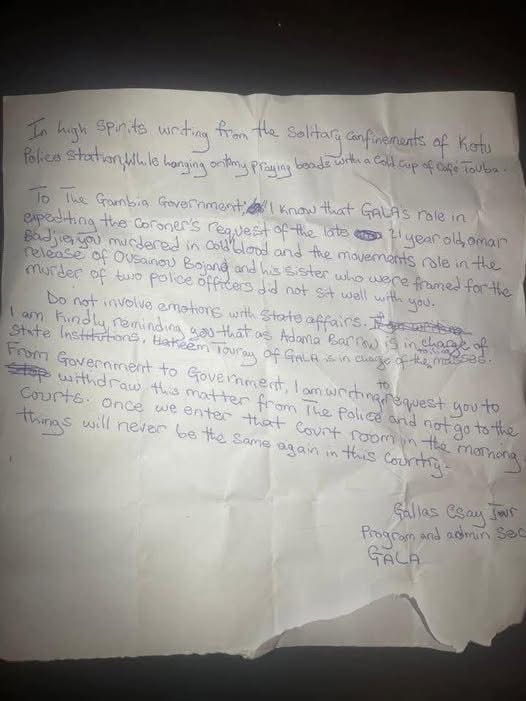
Placing Gallas Fallou Ceesay’s note from Kotu Police Station within the tradition of African prison literature requires drawing clear distinctions. This genre involves more than simply writing from prison—it is defined by a deep intellectual history, moral significance, and powerful political context.
To invoke names such as Wole Soyinka or Ngũgĩ wa Thiong’o is to reference work rooted in oppression, conviction, and sacrifice. Proposing Ceesay’s note alongside Soyinka, Ngũgĩ, Mandela, and Saro-Wiwa needs careful, historically informed distinction. Prison literature is built on truth, courage, and public service, not simply any writing from incarceration.
African prison literature emerges from moments when the State seeks to silence dissent through incarceration. Its authors — Soyinka, Ngũgĩ, Mandela, Ken Saro‑Wiwa, Jack Mapanje — wrote not to intimidate institutions, but to illuminate the moral crisis of their societies. Their texts were not political warnings; they were ethical interventions.
Wole Soyinka’s The Man Died was written under conditions of extreme isolation during the Nigerian Civil War. His smuggled notes documented the violence of a regime determined to erase dissent. His famous line — “The man dies in all who keep silent in the face of tyranny” — was not a threat to the State; it was a philosophical indictment of moral cowardice.
Ngũgĩ wa Thiong’o’s Detained and Devil on the Cross, written on toilet paper in Kamiti Maximum Security Prison, were acts of cultural resistance. They exposed the machinery of corruption and defended the dignity of the oppressed. Ngũgĩ’s prison writing was grounded in a coherent ideological project: decolonization, linguistic liberation, and the democratization of culture.
Putting Gallas Fallou Ceesay’s note in this tradition calls for intellectual honesty, and that means making clear distinctions. His statement that “things will never be the same again in this country” if court cases go forward isn’t a work of conscience. It’s not a reflection on justice or a deep critique of State power—it’s a conditional threat, a move to ramp up pressure on the courts.
It doesn’t shed light on oppression; it stirs up tension. It doesn’t stand up for the public; it leans on the State. Prison writing earns its place in history when it defends the people, not when it shakes institutions. It becomes part of the canon when it speaks truth to power, not when it tries to scare it.
Treating Gallas’s note as part of this lineage without scrutiny erases key distinctions and diminishes genuine struggle. We must not force comparisons: Gallas’s note is not Soyinka, not Ngũgĩ, and not African prison literature. Not every note from a police cell qualifies for this tradition.
Attempting to place Gallas Fallou Ceesay’s note from Kotu Cell into the same canon as Soyinka’s The Man Died or Ngũgĩ’s Detained is not just careless; it blurs essential boundaries.
Soyinka’s work arose under a military dictatorship that sought to silence him; that is an entirely different context. Ngũgĩ wrote under a regime that feared his ideas. Mandela wrote from a prison designed to break his spirit. These men wrote to liberate nations. Gallas wrote to warn the State.
There is a profound difference. Soyinka smuggled notes out of solitary confinement to expose tyranny. Ngũgĩ wrote on toilet paper when denied materials. Their words embodied courage and moral clarity.
Gallas’s message — “things will never be the same again in this country” — is not a philosophical indictment of injustice but a political threat aimed at influencing a court case.
It escalates tension without defending the people or illuminating oppression. Comparing Gallas’s note to Soyinka or Ngũgĩ diminishes history, struggle, and a tradition built on courage. If we invoke the giants, honor their standards: They wrote to free nations, confronted tyranny, and risked all, not merely political embarrassment. Not every prison note is a manifesto, nor is every detainee a dissident. History will decide what endures—not noise.
Elevating a note from Kotu Police Station to African prison literature misunderstands both history and genre. Africa’s prison-note writers—Soyinka, Ngũgĩ, Mandela, Saro-Wiwa—created works forged in repression and danger.
In contrast, the “Kotu Cell note” emerges from a democracy as a political warning meant to sway judicial decisions—not as a moral witness. Instead of exposing oppression, it provokes tension and puts pressure on the State. It is part of detention rhetoric, not prison literature. Mixing these blurred histories and diminishing past struggles. African prison literature merits respect beyond careless comparison.
Can a police‑station note in a democracy really be compared to the prison writings of Soyinka, Ngũgĩ, Mandela, Jack Mapanje, or Saro‑Wiwa—men who created under authoritarian regimes bent on silencing them?
A new essay suggests that such comparisons oversimplify history, diminish the weight of the struggle, and misread the tradition of African prison literature.
Africa’s notable prison-note writers—Soyinka in solitary confinement, Ngũgĩ writing on toilet paper, Mandela under apartheid, Saro-Wiwa on death row—produced works under regimes that sought to silence them.
Their writings showed moral courage under repression and danger. Equating these texts with one written in a democratic police station trivialises their struggle.
These giants faced the denial of freedom and dignity, and their words were forged under duress, not rhetorical warnings. Comparing the two misrepresents the genre and its history.
Why the “Kotu Cell Note” cannot enter Africa’s prison-writing tradition. The attempt to elevate a note written in Kotu Police Station into the lineage of African prison literature misunderstands the history and genre.
The great prison-note writers—Wole Soyinka, Ngũgĩ wa Thiong’o, Nelson Mandela, and Ken Saro-Wiwa—produced their works under authoritarian regimes determined to silence them.
By contrast, the “Kotu Cell note” comes from a democratic context and serves as a political warning meant to influence courts, not as a document of conscience. It stirs tension, presses the State, but neither defends the public nor reveals oppression.
It represents detention rhetoric, not prison literature.
To conflate these traditions is to flatten history and trivialize a canon built on moral courage. African prison literature is a sacred inheritance, deserving more than careless analogy. It was born in a dictatorship, confronting authoritarianism, not merely judicial processes in a democracy. cheapens a tradition built on moral clarity.
Throughout Africa’s history, prison writings have been powerful testaments to conscience. Born in times of national crisis, by those whose sacrifice, intellect, and courage shaped nations’ futures, this tradition evokes writers who challenged authoritarianism at personal risk.
Modern figures linking themselves to this legacy require an honest, accurate response. Not every prison text joins the canon, nor every detainee is a dissident, every grievance resistance, or every note a moral statement.
he tradition of African prison writing calls for intellectual honesty. The push to place Gallas Fallou Ceesay’s “Kotu Police Station Note” alongside the works of Soyinka, Ngũgĩ wa Thiong’o, Mandela, and Saro‑Wiwa deserves a measured, historically grounded response.
Prison writing is more than just accounts of confinement; it’s a genre with a legacy, moral weight, and a defined structure. Citing its greats invokes a history of sacrifice, clarity, and defiance against repression. “The Kotu Cell Note” belongs to a different genre altogether, and comparing it to this lineage demands honesty.
Honesty calls for clarity. Gallas’s claim that “things will never be the same again in this country” if court cases move forward isn’t a work of conscience. It’s not a reflection on justice or a deep critique of State authority—it’s a conditional threat, a deliberate escalation meant to sway judicial outcomes.
It doesn’t shed light on oppression; it fuels tension. It doesn’t protect the public; it pushes against the State. It doesn’t reveal tyranny; it hints at unrest. This isn’t prison literature—it’s political messaging from behind bars.
Prison literature earns its place in history when it stands for the people, not when it shakes the foundations of institutions. It becomes timeless when it speaks truth to power, not when it tries to intimidate it.
African prison literature isn’t just about defiance—it’s grounded in truth, sacrifice, moral courage, and service. To place Gallas’s note in this tradition without careful thought flattens history, trivializes struggle, and weakens a legacy forged through trauma.
The genre is built on moral clarity, ideological consistency, personal sacrifice, commitment to truth, service to the public good, and resistance to authoritarianism. These aren’t optional; they are its foundation. Soyinka faced execution, Ngũgĩ risked disappearance, Mandela endured life imprisonment, and Saro‑Wiwa was hanged. Their words were shaped by the constant threat of erasure.
Elevating a note written in a police holding cell during a lawful judicial process into this lineage diminishes the immense sacrifices of those who wrote under regimes determined to silence them.
African prison literature is not simply writing produced behind bars; it is a genre defined by moral clarity, ideological coherence, and personal sacrifice.
Wole Soyinka’s The Man Died emerged from nearly two years of solitary confinement during the Nigerian Civil War, where he was denied books, writing materials, and human contact.
His smuggled notes, scribbled on scraps of paper, were not political threats but philosophical indictments of tyranny. His famous line — “The man dies in all who keep silent in the face of tyranny” — was a call to moral courage, not a warning to the State.
Ngũgĩ wa Thiong’o’s Detained and his novel Devil on the Cross, written on toilet paper in Kamiti Maximum Security Prison, were acts of cultural resistance against a regime that feared his ideas. His prison writing was grounded in a coherent ideological project: decolonization, linguistic liberation, and the democratization of culture. Ngũgĩ wrote to defend the dignity of the oppressed, not to escalate political tensions.
Nelson Mandela’s prison writings, later collected in Conversations with Myself, were meditations on justice, reconciliation, and the moral architecture of a future South Africa. They were not attempts to intimidate institutions; they were blueprints for a democratic society.
Ken Saro‑Wiwa’s A Month and a Day, written from death row, documented the brutality of the Nigerian military regime and the ecological destruction of Ogoniland.
His writing was a moral indictment of state violence and corporate exploitation. He wrote knowing he might never leave prison alive, and indeed, he did not. These writers did not write to frighten the State. They wrote to free their nations.
In this context, we must critically assess the attempt to situate Gallas Fallou Ceesay’s note from Kotu Police Station within our literary tradition. His assertion that “things will never be the same again in this country” if court cases proceed is not a courageous act of conscience. It is neither a profound reflection on justice nor a thoughtful critique of state authority; it amounts to a conditional threat—a tactical maneuver aimed at swaying the courts.
This statement does not illuminate oppression; it provokes unrest. It does not advocate for the public’s well-being; it seeks to coerce the state. It does not reveal tyranny; it alludes to chaos. This is not prison literature; it is political messaging crafted from behind bars.
Genuine prison writing gains its rightful place in history when it stands up for the people, not when it seeks to destabilize institutions. It enters the literary canon when it speaks truth to power, not when it aims to intimidate it. To elevate Gallas’s note as part of this tradition is to misinterpret both the significance of history and the essence of literature.
The ethics of the genre: why the comparison doesn’t hold up. African prison writing is built on moral clarity, ideological focus, personal sacrifice, dedication to truth, service to the public good, and defiance of authoritarianism.
These aren’t optional—they’re the very core of the tradition. Soyinka faced execution. Ngũgĩ risked vanishing without a trace. Mandela endured life imprisonment. Saro‑Wiwa was hanged. Their work emerged from life‑threatening situations.
To place a note from a police holding cell during a lawful judicial process in this lineage is to downplay the sacrifices of those targeted by regimes determined to erase them. It blurs the line between political protest and literary resistance, and between heated rhetoric and moral witness.
The problem with forced analogies is that they lead to three big mistakes. First, they downplay real oppression by comparing democratic policing to the horrors of apartheid, military rule, or one‑party states.
Second, they water down the literary tradition by labeling any writing done in confinement as literature. Third, they skew the moral direction of activism by confusing pressure tactics with genuine principled resistance.
Prison writing is about truth‑telling, not political leverage. It’s a record of witness, not a warning. Gallas’s note, in reality, is a political statement, not a literary achievement.
It’s a spark of agitation, not a piece of African prison literature. It fits more into detention rhetoric than true prison writing. It’s a work of pressure, not philosophy; a warning, not a witness; an act of escalation, not deep reflection.
To raise it without critique is to misunderstand both history and literature.
African prison literature is a powerful tradition, born of sacrifice, struggle, and moral conviction. It honors those who wrote to liberate their nations, not to intimidate them.
To truly respect the legacies of Soyinka, Ngũgĩ, Mandela, and Saro‑Wiwa, we must protect the integrity of the tradition they shaped. Gallas’s note should be seen for what it is—a political statement from behind bars, not a work that belongs to the canon of African prison writing. In the end, history will choose what lasts, and it cannot be swayed by mere noise.
When we try to bend history to fit our current moment, we make three big mistakes. First, we trivialise real oppression by comparing something like police detention in a democracy to the horrors of apartheid, military rule, or one-party states—it’s just not the same.
Second, we cheapen literature by assuming every piece written in confinement is art, that every complaint is resistance, and every detainee is a dissident.
Third, we skew activism’s moral compass—prison writing is about truth-telling, not political maneuvering. As for Gallas’s note, it’s a political statement, not a literary landmark; a burst of agitation, not a page in African prison literature.
It’s detention rhetoric, not deep philosophy; a warning, not a personal witness; an escalation, not moral reflection. To elevate it without question is to misread both history and literature.
Let’s be honest: not every note from a police cell counts as African prison literature. Trying to place Gallas Fallou Ceesay’s “Kotu Police Note” alongside works like Soyinka’s The Man Died or Ngũgĩ’s Detained isn’t just sloppy — it disrespects the legacy. Soyinka wrote under a dictatorship that silenced him, Ngũgĩ under a regime that feared his voice, Mandela from a prison built to crush his spirit.
These men wrote to free nations. Gallas wrote to warn the State. That’s a big difference. Soyinka smuggled words from solitary confinement to expose tyranny; Ngũgĩ scribbled on toilet paper when denied materials. Their writing was born of courage, sacrifice, and moral clarity.
Gallas’s statement — “things will never be the same again in this country” — isn’t a deep reflection on injustice. It’s a political threat, a pressure move meant to sway a court case. It doesn’t stand up for the people; it leans on institutions. It doesn’t shed light on oppression; it stirs up tension.
Prison literature isn’t just about defiance—it comes from truth, sacrifice, and a commitment to the public good. Comparing Gallas’s note to Soyinka or Ngũgĩ flattens history, trivializes struggle, and diminishes a tradition built on blood, courage, and moral clarity.
If we’re going to invoke the giants, we should honor their standards: they wrote to free nations, not scare them; they stood up to tyranny, not legal proceedings; they risked death, not political embarrassment. We need to stop bending history to fit our moment.
Not every prison note is a manifesto, not every detainee a dissident, and not every message literature. History will decide what lasts—and it won’t be fooled by sycophancy or political hypocrisy.
History is generous, but also discerning. African prison literature is a powerful tradition of sacrifice, courage, and moral clarity. It honors those who wrote to liberate their nations, not to intimidate them. To truly respect Soyinka, Ngũgĩ, Mandela, and Saro-Wiwa, we must protect the integrity of what they built.
So let’s see Gallas’s note for what it is: a political message from detention, not an addition to the canon of African prison writing. In the end, history will decide what lasts, and it’s never fooled by mere noise.
By Alagi Yorro Jallow

FOOTNOTES
Wole Soyinka, The Man Died: Prison Notes of Wole Soyinka (London: Rex Collings, 1972).
Ngũgĩ wa Thiong’o, Detained: A Writer’s Prison Diary (London: Heinemann, 1981).
Nelson Mandela, Conversations with Myself (New York: Farrar, Straus and Giroux, 2010).
Ken Saro‑Wiwa, A Month and a Day: A Detention Diary (London: Penguin, 1995)







Recent Comments