
The Gambia’s electoral history shows that political competition has long been resolved through ballots rather than bloodshed. That is why Lawyer Ousainou Darboe’s admission that he felt “embarrassed” by the need for a Peace Pact struck such a powerful chord.
The pact matters because it sharpens a central question: can Gambian democracy still match its tradition of respect for election results, the IEC, the courts, press freedom, and truth itself? In an era of political polarization, declining civility, institutional distrust, digital disinformation, deepfakes, and AI-generated deception, the answer matters more than ever.
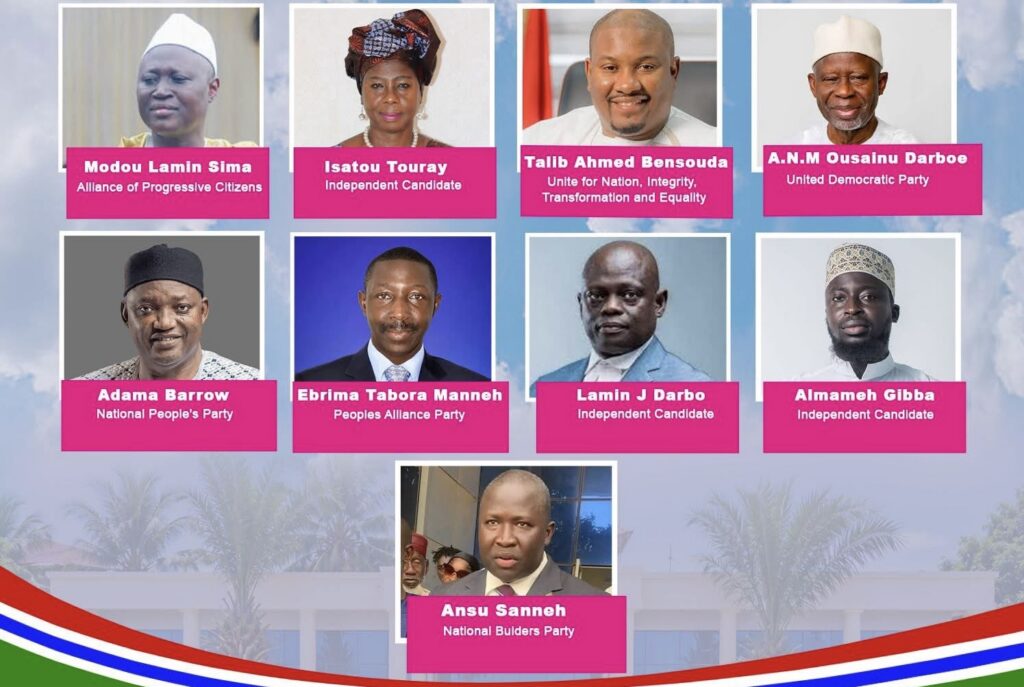
Presidential candidates signing the Peaceful Elections Pact ahead of the December 5 presidential election marks an important moment in Gambian democracy’s evolution.
Organised by the Independent Electoral Commission (IEC) in partnership with democracy-support institutions, the agreement commits candidates and political parties to peaceful political competition, rejects violence and intimidation, protects media freedom, and calls for responsible conduct throughout the campaign period. As a statement of intent, the pact deserves support.
No democracy benefits from political violence. No nation prospers when elections become occasions for fear rather than civic participation. At a time when democratic processes across the continent face increasing strain from polarisation, misinformation, and political hostility, any commitment to peaceful conduct should be welcomed.
Yet the deeper issue is not the ceremony itself. It is what the Peace Pact reveals about the state of our democracy and whether it can sustain peaceful competition and institutional respect.
Unlike many countries where elections have triggered widespread ethnic conflict, bloodshed, displacement, and prolonged instability, The Gambia’s democratic history tells a different story. Since independence in 1965, the country has largely settled political disputes through ballots rather than violence.
Before the military interruption of constitutional rule in 1994, elections were competitive, peaceful, and regular. Governments won and lost support. Opposition parties challenged incumbents. Political disagreements often ran deep. Yet electoral violence never became a defining characteristic of Gambian politics.
Even during the authoritarian era that followed the 1994 coup, despite serious concerns about political freedoms and democratic deficits, election periods did not descend into the large-scale violence witnessed elsewhere on the African continent. This historical context matters.
The Gambia is not a nation discovering democratic culture for the first time. It is a nation with a long electoral tradition interrupted by authoritarian rule but never completely stripped of its democratic instincts. Elections have remained central to political legitimacy throughout our modern history. That reality sharpens the central argument here: the Peace Pact matters less as a novelty than as a test of whether Gambian democracy can still uphold peaceful competition and respect for institutions.
UDP Secretary-General and party leader Lawyer Ousainou ANM Darboe delivered perhaps the most reflective speech of the event. His admission that he felt “embarrassed” by the very necessity of the pact was striking not because it dismissed peace, but because it challenged Gambians to think more deeply about what democracy should require of its citizens and leaders.
Darboe recalled an earlier generation of politics, including his father’s, when electoral competition took place without peace agreements, formal declarations, or elaborate pledges. Political actors campaigned vigorously, disagreed passionately, and sought power energetically, yet they did so while respecting one another’s humanity and legitimacy. They saw one another as competitors, not enemies.
His point is clear: Why has politics become so polarized that leaders now need to sign documents promising to behave peacefully? His challenge was not directed against the pact itself. Rather, it reminded everyone that peaceful coexistence should be a democratic norm, not an exceptional commitment.
A healthy democracy should not require political actors to promise not to engage in violence. Such conduct should already be understood as a civic obligation. In that sense, the Peace Pact serves not merely as a peacebuilding instrument but as a reflection of contemporary political anxieties.
It also sharpens the deeper test: whether political actors will respect election outcomes, because the greatest threat to democracy is often not election-day violence but post-election rejection of legitimate results.
Across the world, democratic crises regularly emerge not when citizens vote but when political actors refuse to accept the verdict of voters. That is why future democratic agreements should go further than commitments to peace. They should contain explicit undertakings by all candidates to respect certified election results, pursue grievances exclusively through constitutional channels, and accept final determinations reached through lawful institutional processes.
Any meaningful discussion of democratic consolidation must place greater emphasis on institutions. The Independent Electoral Commission is the constitutional referee of the electoral process. Like every referee, it will occasionally make decisions that participants dislike.
Disputes, criticism, and scrutiny are natural in democratic societies. Yet political parties cannot celebrate the IEC’s credibility when they win and dismiss its legitimacy when outcomes become unfavorable. Confidence in elections requires confidence in the institutions that administer them.
The same principle applies to the judiciary. Courts exist precisely because democratic societies understand that disagreements are inevitable. Electoral disputes, constitutional questions, and political grievances require peaceful mechanisms of resolution.
Candidates who believe they have been wronged are entitled to seek judicial review. That right is fundamental to democracy. However, democracy also demands that political actors respect judicial outcomes once they have exhausted lawful avenues of challenge.
The rule of law cannot function if people embrace court victories while denouncing court defeats as illegitimate. Constitutional democracy requires consistency.
The true democrat is not the person who respects institutions only when they agree with him. The true democrat respects institutions because he recognizes that they are larger than any individual ambition.
In that sense, one of the most significant indicators of democratic maturity is a collective willingness to place faith in independent institutions even during moments of disappointment.
Modern politics often misunderstands concession. Too many politicians view conceding defeat as a personal humiliation rather than a democratic responsibility. In reality, accepting electoral defeat may be among the highest expressions of democratic faith.
It acknowledges that sovereignty resides with the people and that citizens lend political authority, not politicians. Every election produces a winner and a loser.
A democracy’s strength depends on how both respond to the outcome. The winner must govern with humility.
The loser must concede with dignity.
A peaceful concession does not weaken democracy. It strengthens it. It tells citizens that constitutional order matters more than personal ambition and that national stability matters more than individual political fortunes.
The peaceful transfer of authority remains one of humanity’s greatest democratic achievements. No Peace Pact will have fulfilled its purpose unless candidates are equally committed to accepting the people’s verdict when the ballots are counted.
One of the most powerful moments of the signing ceremony may not have been found in the speeches at all. It was visible in the images. President Adama Barrow greeting and shaking hands cordially with fellow presidential contenders sent an important democratic signal.
To some observers, it may have appeared routine. In reality, such images matter. Around the world, political opponents increasingly portray one another as enemies rather than competitors.
Public discourse has become more hostile, more tribal, and more polarised. Against that backdrop, the simple act of rivals exchanging courtesies carries significance. It demonstrates that fierce political competition and mutual respect can coexist.
Democracy is strengthened when political leaders model civility, restraint, and respect. Supporters often take their cues from leaders. If leaders can shake hands, supporters can coexist. The images from Bilirabongile reflected more than protocol. They reflected democratic maturity.
While much public attention has focused on commitments against violence, Article 3 of the Peace Pact may ultimately prove to be its most forward-looking and consequential provision.
The article addresses press freedom, digital media, and artificial intelligence, recognising that democratic threats today are increasingly technological rather than physical. The battlefield of modern elections is no longer confined to rallies and polling stations. It increasingly exists online.
Artificial intelligence has introduced new threats that can undermine democratic integrity at unprecedented speed. Deepfake videos can manufacture events that never occurred. Cloned voices can fabricate political statements. Manipulated images can spread false narratives. Bot networks can amplify lies. Troll farms can distort public debate.
Coordinated disinformation campaigns can undermine public trust in institutions before the truth has a chance to catch up. The danger is not merely misinformation. The danger is the gradual erosion of trust itself. When citizens can no longer distinguish fact from fabrication, democracy becomes vulnerable because informed choice becomes impossible.
Including provisions requiring candidates to reject deepfakes, avoid manipulated content, disclose AI-generated campaign material, and combat digital falsehoods reflects an important recognition of the realities of twenty-first-century politics.
However, commitments alone are insufficient. Article 3 requires implementation, monitoring, enforcement, and public accountability.
One of the enduring assumptions in African politics is that threats to democracy arrive dramatically, through coups, armed conflict, or overt political repression.
Increasingly, however, quieter, less visible forces are weakening democracy. A fabricated video shared thousands of times on social media. A cloned voice falsely attributed to a candidate. A manipulated photograph spread through WhatsApp groups.
Anonymous troll networks designed to provoke outrage and divide communities. These tools do not destroy democracy through force. They undermine it through confusion.
The most dangerous consequence is not that citizens believe a particular falsehood. It is that they stop believing anything at all. Democracy depends upon a shared foundation of facts. Political parties may disagree on solutions, ideology, or leadership, but they cannot function if truth itself becomes negotiable.
That is why Article 3 may ultimately become the most historic provision of the Peace Pact. It recognises that defending democracy in the twenty-first century is no longer confined to protecting polling stations.
It also requires protecting the information environment in which citizens make political choices. A voter intimidated by violence loses freedom. A voter deceived by falsehood loses it as well.
The challenge before political parties is therefore larger than keeping the peace. It is preserving public trust in democratic truth.
Political parties should establish internal digital ethics protocols and disciplinary mechanisms for supporters who knowingly circulate false information. Independent fact-checking organizations should receive institutional support during the campaign period.
Civil society groups, the Media Council, the Gambia Press Union, technology platforms, and the IEC should collaborate to quickly and transparently identify and expose fabricated content.
Campaigns should be encouraged to designate digital compliance officers to ensure adherence to Article 3. Repeated violations should be publicly documented and reported. Equally important is protecting journalists. Journalists are not opponents in elections.
They are not enemies of government or opposition. Their responsibility is to inform citizens, verify claims, investigate power, and promote accountability. The pact’s commitments to ensure journalists’ safety, prevent harassment, respect due process, and guarantee access to information deserve rigorous enforcement.
Ousainou Darboe’s warning is particularly relevant here. If Article 3 is not implemented in practice, it risks becoming exactly what he cautioned against: a document signed for the cameras and forgotten when it matters most.
Ultimately, the success of this Peace Pact will not be measured by the elegance of the ceremony, the number of signatures gathered, or the photographs taken for tomorrow’s newspapers. Its success will be measured by conduct.
It will be measured by whether political leaders reject inflammatory rhetoric even when it is politically convenient. It will be measured by whether supporters treat opponents as fellow citizens rather than enemies. It will be measured by whether journalists can perform their duties without intimidation.
It will be measured by whether artificial intelligence is used responsibly rather than deceptively. It will be measured by whether constitutional institutions are respected, even when their decisions disappoint political ambitions.
Long after the campaign posters fade, long after the rallies end, and long after the last ballot is counted, one question will remain. Did this election strengthen the democratic culture of The Gambia?
The answer will not be found in the signing ceremony. It will not be found in speeches or photographs. It will be found in the conduct of political leaders, supporters, institutions, journalists, and citizens.
A mature democracy is not one without disagreement. It knows how to manage disagreement peacefully. It is one where opponents compete fiercely but recognise each other’s legitimacy. It is one where courts are respected even when their decisions are unpopular.
It is one where electoral commissions are trusted even when outcomes disappoint. It is one where journalists can ask difficult questions without fear. It is one where technology serves truth rather than deception.
Most importantly, it is one where candidates understand that political power belongs neither to presidents nor parties, but to the people. Perhaps that was the deeper meaning behind Ousainou Darboe’s embarrassment.
He was reminding Gambians of something previous generations understood instinctively: democracy is not sustained by pacts alone. Habits, values, restraint, and mutual respect sustain it. The handshakes witnessed in Bijilo were encouraging. They symbolised a nation capable of political competition without political hatred.
Yet the real handshake will come after December 5, when winners and losers alike accept the verdict of the Gambian people. That moment, more than any signature on paper, will reveal the true maturity of Gambian democracy.
Above all, it will be measured by whether candidates accept the sovereign verdict of the Gambian people after the election. For that is the highest test of democratic maturity. Peace before elections is important. Respect during elections is essential.
But genuine democratic maturity is demonstrated after elections, when winners exercise restraint, losers show dignity, institutions command confidence, and citizens accept that the ballot box, not anger or ambition, is the final arbiter of political power.
That is the democratic tradition The Gambia inherited. That is the democratic culture worth preserving. And that is the democratic maturity the nation must keep building long after the handshakes have ended and the ballots have been counted.
By Alagi Yorro Jallow







Recent Comments