Democracy is not merely the right to vote; it is the right to make an informed choice. As Gambians prepare to elect their next President, citizens deserve more than rallies, slogans, motorcades, social media campaigns and carefully scripted speeches.
They deserve the opportunity to see those seeking the highest office confront one another openly, defend their records, explain their policies and demonstrate their readiness to govern.
Before we hand over the keys to State House, we should ask those seeking to occupy it to sit before the nation and explain why they deserve that privilege.
A presidential debate would improve not only an election campaign but also the quality of Gambian democracy. The IEC has certified the candidates, and the voters deserve to hear them. All nine candidates should debate before the December 5, 2026 presidential polls.
As the nation moves beyond presidential nominations and toward another decisive election, one crucial question remains absent from our political discourse: why should anyone be entrusted with leading The Gambia without first demonstrating, before the people, a clear understanding of the challenges confronting the nation and a credible vision for addressing them?
The presidency is not a reward for political longevity, personal ambition or electoral popularity. Nor is it an entitlement conferred by prophecy, destiny, rhetoric or a sense of historical inevitability.
In a democracy, no individual possesses a divine right to govern. Political authority derives its legitimacy solely from the people’s informed consent.
The Gambian voter is not electing a career politician, a gifted storyteller, a charismatic crowd-puller, or a candidate seeking to crown a résumé with the highest office in the land. Citizens are choosing a public servant upon whom they will confer immense constitutional authority and an extraordinary duty of stewardship over the Republic.
For that reason, voters are entitled to ask more than who a candidate is. They are entitled to ask what that candidate knows, what values guide them, what policies they propose, what judgment they possess, and what capacity they have to turn promises into results.
The true measure of a presidential candidate is not eloquence alone, nor proficiency in English, Arabic, or any other language. It is the ability to exercise sound judgment, uphold constitutional values, inspire public confidence, and provide competent leadership in moments of challenge and opportunity.
A President is not elected to rule over the people. A President is elected to serve them. In a democracy, service must be earned before authority is granted.
In many respects, the maturation of Gambian democracy will not be judged solely by whether nine presidential candidates are on the ballot or whether elections are peaceful and credible.
It will also be judged by whether citizens are empowered to make informed choices. A presidential debate involving all nine candidates would signal that our democracy is moving from personality and rallies toward ideas, accountability, and informed citizenship.
The IEC has completed its task. The voters are ready. The nation is watching. Now let the candidates speak to one another and to the Gambian people. That call is especially relevant after the Independent Electoral Commission announced the final list of candidates cleared to contest the 5 December 2026 presidential election.
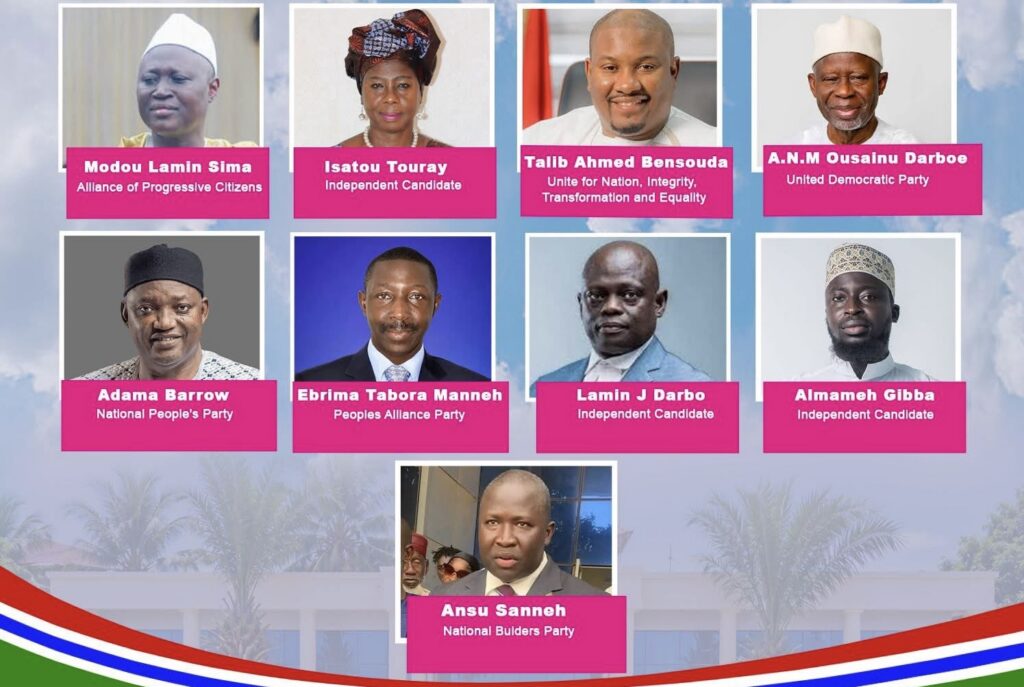
The IEC has endorsed nine candidates: Modou Lamin Sima of the APC, Isatou Touray (Independent), Ansu Sanneh of the NBP, Talib Ahmed Bensouda of UNITE, Ebrima Tabora Manneh of the PAP, A.N.M. Ousainu Darboe of the UDP, President Adama Barrow of the NPP, Lamin J. Darbo (Independent) and Almameh Gibba (Independent).
With the field now officially settled, the national conversation should move beyond who has qualified and focus instead on a more fundamental question: how do these candidates intend to govern?
The forthcoming presidential election offers more than a chance to choose a leader; it offers a chance to elevate the quality of Gambian democracy itself. One effective way to do this is through nationally televised presidential debates involving all qualified candidates.
Before citizens entrust any individual with the immense responsibilities of State House, candidates should be prepared to stand before the nation and defend their ideas, records, and programs in an open contest of reason.
Democracy is not simply voting. It flourishes when citizens make informed choices based on facts, competing visions, and meaningful scrutiny.
Elections should therefore be moments when candidates submit themselves to public examination rather than carefully managed exercises in political marketing.
Presidential debates provide such a platform.
For far too long, political confrontation in The Gambia has been conducted through rallies, press conferences, press releases and, increasingly, social media exchanges where accusations often substitute for arguments and slogans replace substance.
Political competitors frequently speak about one another rather than to one another. The result is a public sphere saturated with noise but often deprived of genuine engagement. A presidential debate would change that dynamic.
Instead of trading accusations from a distance, candidates would confront each other’s proposals directly. Instead of asking voters to accept promises on faith, they would be required to defend them with evidence.
Instead of reducing politics to personality contests, debates would place competence, ideas, and policy choices at the center of democratic decision-making. The Gambian people deserve no less.
A mature democracy requires more than the freedom to campaign. It requires the courage to answer difficult questions. Citizens should have the opportunity to hear candidates explain, side by side, how they intend to tackle youth unemployment, economic growth, inflation, education reform, healthcare delivery, agricultural productivity, corruption, constitutional reform, environmental sustainability and national cohesion.
These matters should not be reduced to campaign slogans or partisan chants. The nation deserves clarity.
One persistent weakness of Gambian political culture has been the tendency to reward rhetoric while demanding too little detail. Politicians often offer broad promises of transformation, prosperity, and development.
Yet voters are rarely given opportunities to interrogate these promises rigorously. How will these policies be financed? What institutional reforms are required? What timelines are realistic? What lessons have been learned from previous failures?
A well-organised presidential debate would compel candidates to answer these questions.
Civil society organisations, the Gambia Press Union, universities, professional associations and media institutions should collaborate to establish a nonpartisan debate framework. The objective should be to strengthen democratic accountability, not to produce political theatre.
Organise multiple debates around thematic issues. One debate could focus on governance and constitutional reform. Another could examine economic management and job creation.
A third might address education, healthcare, agriculture, and social protection. This approach would move political discussion beyond personality-driven campaigns toward serious consideration of public policy.
Crucially, modern debates should not end when candidates leave the stage. To maximise their democratic value, debates should be paired with rigorous, independent fact-checking.
Independent experts and credible media institutions should verify claims about economic performance, infrastructure development, public finances, employment figures, and governance records.
Political discourse becomes healthier when facts challenge fiction. Those uncomfortable with accountability should fear such a process.
One objection occasionally raised against presidential debates is that they may disadvantage candidates who are not entirely comfortable expressing themselves in English.
Such concerns misunderstand the purpose of democratic engagement. A presidential debate is not meant to test proficiency in a colonial language. It is to evaluate a candidate’s understanding of national challenges and readiness to govern.
English remains our official language and has an important place in public administration and state affairs. Yet democracy should never become a competition of accents, vocabulary or grammatical perfection.
Many Gambians, including highly educated professionals, academics and public servants, are often more persuasive, authentic and eloquent when discussing complex issues in their mother tongues. A truly Gambian presidential debate should embrace our linguistic diversity.
Candidates should be free to engage in English, Mandinka, Wolof, Fula, Jola, Serer, Sarahuleh, or any other national language, with interpretation provided where necessary. Such an approach would deepen inclusiveness and legitimacy without diminishing the quality of debate.
The Gambian voter is not electing an English teacher. Beyond rallies, motorcades and political spectacle, the true strength of a democracy cannot be measured by the size of campaign crowds, the length of motorcades, or the volume of applause at political rallies.
Crowds can be mobilised. Songs can be commissioned. Social media narratives can be manufactured. Political branding can be polished.
But none of these things tells citizens whether a prospective president understands fiscal policy, constitutional reform, institutional strengthening, security sector governance, agricultural transformation, or economic development.
Only serious engagement can do that. Only debate can expose the difference between preparation and performance. Only debate can reveal whether a candidate possesses the intellectual depth, emotional temperament, and policy competence required to govern a modern state.
The presidency is too important to be awarded on campaign choreography alone. Indeed, examples from East Africa provide useful lessons. In Kenya, public discourse and political engagement routinely move between English and Kiswahili, and observers have argued that national debates should be conducted in both languages to ensure broader citizen participation and understanding.
In the Kenyan Parliament, both English and Kiswahili are recognised languages of debate, reinforcing the principle that democratic participation strengthens when leaders communicate in languages ordinary citizens understand.
Similarly, Kiswahili plays a central role in public life, governance and political communication across Tanzania and much of East Africa, where the use of indigenous languages has long been associated with wider citizen engagement and national integration.
The lesson for The Gambia is straightforward. Democratic competence should not be measured by English fluency alone.
It should be measured by the ability to communicate ideas clearly to citizens and to articulate credible solutions to national challenges. The Gambian voter is not electing an English teacher. The Gambian voter is electing a President.
Indeed, if some presidential candidates remain reluctant to participate directly in such debates, another democratic alternative remains available.
Campaign managers, policy directors and senior party representatives could participate in structured policy debates on behalf of their parties or coalitions.
Such engagements would still provide immense value to the electorate. They would offer voters an opportunity to understand how competing parties intend to govern and what distinguishes one program from another.
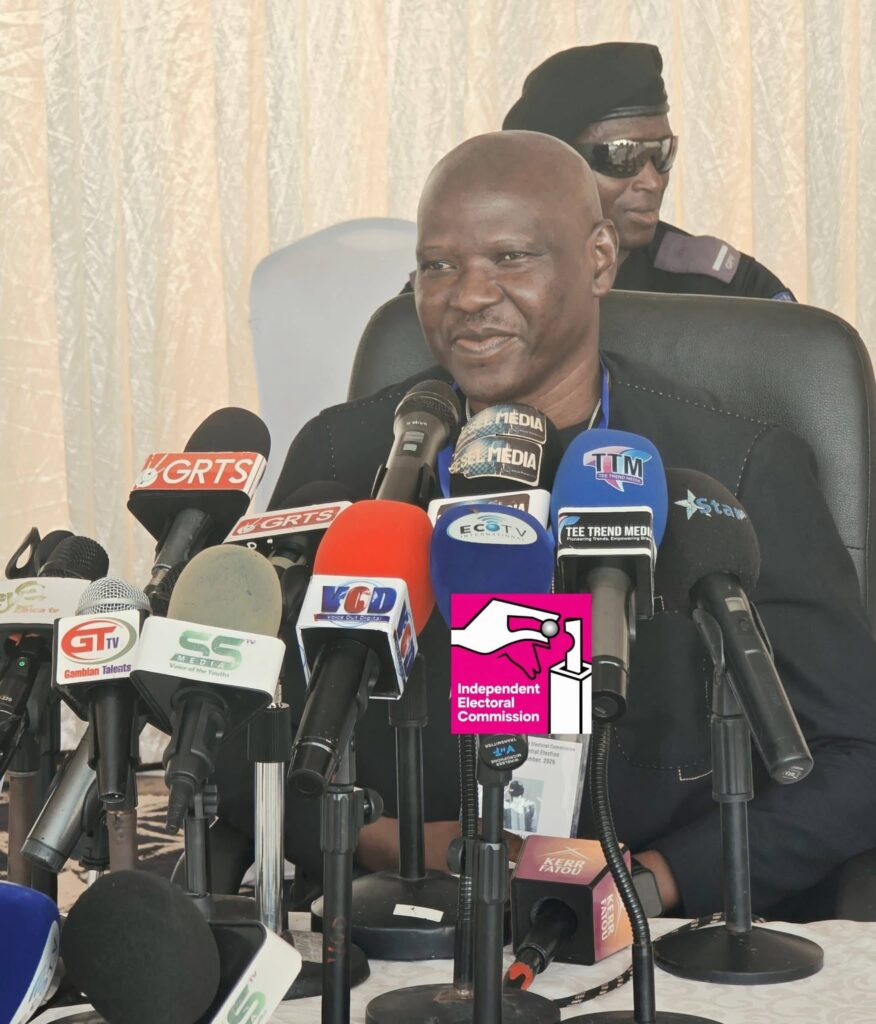
Elections should not merely be contests between personalities. They should be contests between ideas. The recent interactions organised by the Independent Electoral Commission offered a glimpse of what such democratic engagement can achieve.
Through that platform, journalists could ask presidential aspirants direct questions. Citizens learned things they might otherwise never have heard.
Significantly, President Adama Barrow publicly addressed presidential term limits in that forum, demonstrating the value of structured engagement between candidates and the media.
The lesson is simple but profound: when democratic institutions create spaces where leaders can be questioned directly, democracy itself benefits. Citizens become better informed. Candidates are compelled to clarify their positions. Public debate becomes richer. Accountability deepens. This is precisely why debates matter.
The true strength of a democracy cannot be measured by the size of campaign crowds, the length of motorcades or the volume of applause at political rallies.
Crowds can be mobilized. Songs can be commissioned. Social media narratives can be manufactured. Political branding can be polished.
But none of these things tells citizens whether a prospective president understands fiscal policy, constitutional reform, institutional strengthening, security sector governance, agricultural transformation, or economic development.
Only serious engagement can do that. Only debate can expose the difference between preparation and performance. Only debate can reveal whether a candidate possesses the intellectual depth, emotional temperament, and policy competence required to govern a modern state. The presidency is too important to be awarded on campaign choreography alone.
The call for presidential debates is not a call for political entertainment. Nor is it an attempt to trap candidates or manufacture electoral winners and losers. It calls for democratic maturity. The Gambia’s democratic journey since 2016 has expanded freedoms and widened civic participation.
Yet democratic consolidation requires more than periodic elections. It requires stronger institutions, deeper accountability, and a more informed electorate.
Presidential debates would represent an important step in that journey. They would challenge candidates to defend their records rather than merely celebrate them. They would require plans to back up promises. They would expose empty rhetoric while rewarding preparation, substance, and competence. They would encourage accountability before entrusting power, rather than after mistakes are made.
Most importantly, they would shift our politics from personalities to policies, from slogans to solutions, and from unquestioning loyalty to informed citizenship. The ultimate beneficiaries would not be the candidates. They would be the Gambian people.
The official campaign period begins on 16 November and concludes on 3 December. During this period, candidates will unveil platforms, make promises, and highlight political differences.
Yet no campaign event can inform voters more effectively than a well-organized debate in which all nine candidates confront the same issues under the same conditions.
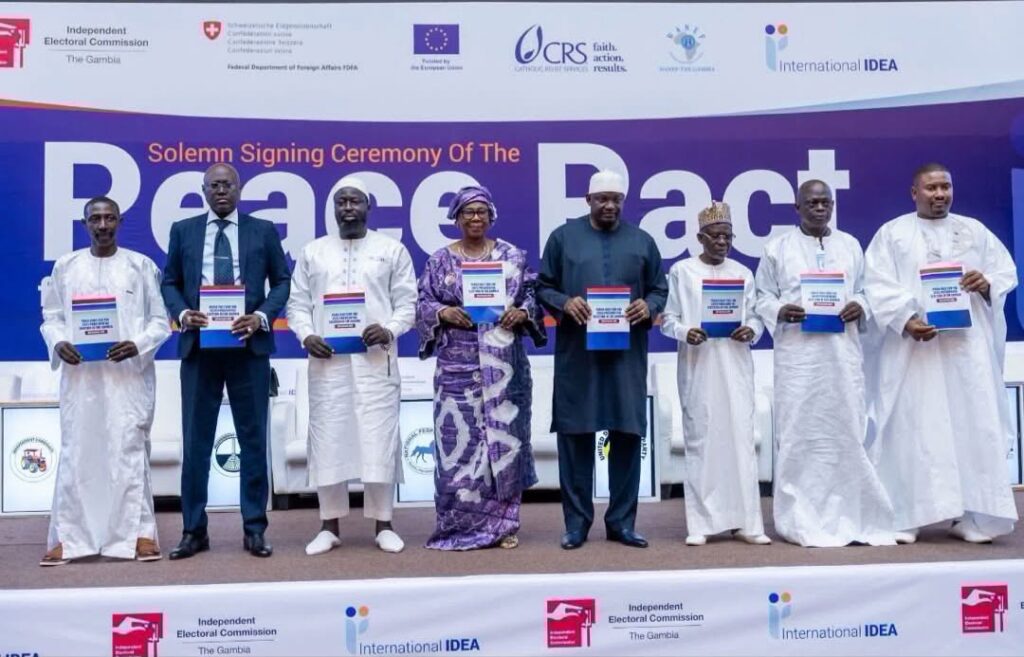
Signing a Peace Pact among candidates is an important commitment to peaceful competition. But democracy demands more than peaceful elections. It also requires informed elections. Political peace ensures stability; public debate ensures accountability. The two should go hand in hand.
The Gambian people deserve to hear directly from every candidate seeking their vote. They deserve to compare visions for governance, assess plans for economic development, evaluate proposals for institutional reform, and judge for themselves who possesses the competence, integrity, and leadership required by the presidency.
Before we hand over the keys to State House, we should first ask the nine candidates now officially approved by the IEC to sit before the nation and explain why they deserve that privilege. The electorate has been presented with a choice. It now deserves a meaningful opportunity to compare those choices directly.
Let them debate. Let them answer difficult questions. Let them defend their records. Let them explain their promises. Let them articulate not only what they oppose, but what they propose.
Let them speak in English if they choose. Let them speak in Mandinka, Wolof, Fula, Jola, Serer, Sarahuleh, or any language that allows them to communicate honestly and effectively with the people. Let journalists question them. Let independent fact-checkers scrutinise them. Let citizens judge them.
Democracy reaches its highest expression not when leaders speak uninterrupted, but when they are questioned without fear, challenged without favor, and evaluated without prejudice. A nation does not discover the strength of a future president when supporters cheer at a rally.
The Gambian people deserve to hear directly from every candidate seeking their vote. They deserve to compare visions for governance, assess plans for economic development, evaluate proposals for institutional reform, and judge for themselves who possesses the competence, integrity, and leadership required by the presidency.
The moment of truth arrives when a difficult question is asked, the applause fades, and the candidate must rely not on slogans, advisers or carefully crafted talking points, but on judgment, knowledge and conviction.
That is why democracies debate. That is why democracies mature. That is why democracies endure. And that is why, if The Gambia is serious about deepening its democratic culture, the time has come for one simple but transformative demand.
A democracy does not become stronger when politicians speak more; it becomes stronger when citizens question them. Whether in English, Mandinka, Wolof, Fula, Jola, Serer, Sarahuleh, or any other Gambian language, the principle remains the same: those who seek to lead the nation must first be prepared to explain themselves before the nation.
Let the debates begin. If you ask for our votes, be prepared to answer our questions. Let the debates begin.
By Alagi Yorro Jallow




Recent Comments