Karl Marx famously stated, “History repeats itself, first as a tragedy, second as a farce.” At the same time, Mark Twain expressed a similar sentiment: “History does not repeat itself, but it often rhymes.”
The ‘rotational governance playbook,’ a political strategy modelled on the Putin–Medvedev tandem in Russia, is being misapplied in Senegambia.
This strategy, which involves a leader stepping down to allow a successor to take over before returning to power, is not suitable for Africa’s political identity, which rejects choreography disguised as constitutional order.
In the ever-shifting and fragile political terrain of The Gambia and Senegal, two parallel dramas are unfolding. These are not just political events, but significant moments that will shape the future of these nations. They are marked by alliances that are at once fragile and significant, contested legitimacy, and the precarious transition from resistance to governance.
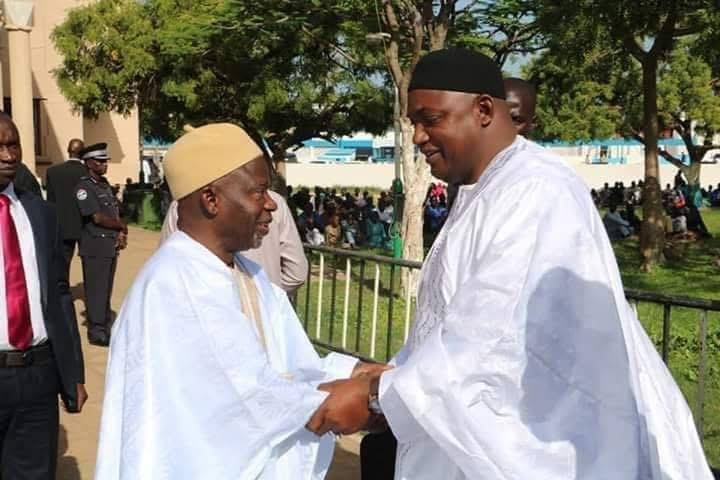
At the core of The Gambia’s metamorphosis lies the once unshakable bond between Ousainou Darboe, the seasoned opposition leader, and his former protégé, Adama Barrow. Their alliance, born in the crucible of dictatorship, held the promise of democratic rejuvenation.
Still, now, the future is shrouded in uncertainty, leaving us all with a sense of concern and the need for active engagement.
However, once in power, Barrow dismissed Darboe and his United Democratic Party (UDP) cabinet members, severing ties with the movement that propelled him to the presidency.
In their stead, he established the National People’s Party (NPP), turning former allies into fierce adversaries and reshaping the narrative of loyalty and betrayal in Gambian politics.
Across the border in Senegal, a sharp power struggle and leadership rift emerge between President Bassirou Diomaye Faye and Prime Minister Ousmane Sonko. This tension deepens within the ‘Diomaye Coalition for President’, a pivotal political entity that played a significant role in Diomaye Faye’s 2024 election.
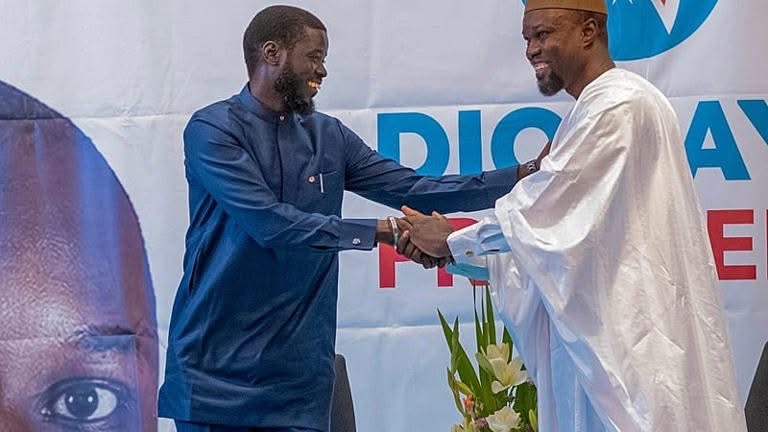
The conflicting announcements about who leads the coalition underscore the growing strains within the country’s leadership amid financial uncertainty and ongoing negotiations with the International Monetary Fund (IMF).
While both Faye and Sonko have repeatedly denied reports of a power struggle, the disagreement over coalition leadership has reignited speculation of internal friction between the two leaders.
Sonko, a charismatic politician with strong youth support, was barred from running in the 2024 presidential election and endorsed Faye as his successor. After Faye’s victory, he appointed Sonko as prime minister, a move initially seen as a display of unity within Pastef.
President Bassirou Diomaye Faye, elected under this broad coalition banner, has initiated a strategic reorganisation of his political apparatus. The dismissal of Aïda Mbodj, a staunch supporter of Prime Minister Ousmane Sonko, and the appointment of Aminata Touré, a seasoned political figure and former prime minister, as the coalition’s coordinator signal a decisive shift.
Touré, who is a loyalist to President Faye, is tasked with restructuring a coalition plagued by internal lethargy and division.
Her appointment, while framed as a move toward efficiency and inclusivity, also reflects Diomaye’s intent to assert presidential authority amid growing tensions with Sonko, whose popular legitimacy and legislative dominance challenge the traditional boundaries of executive power.
These developments in Banjul and Dakar serve as a stark reminder to Senegambian readers that revolutionary alliances, no matter how principled or passionate, must evolve into coherent institutions or risk collapse.
They also prompt contemplation on the essence of leadership, loyalty, and the civic duty to protect democratic transitions from the corrosive allure of personal power. In governance, our role in this protection is not just crucial; it is indispensable. Our actions can make a significant difference, empowering you to take an active role in shaping your country’s future.
Our engagement is not just a choice, but a necessity for the preservation of democracy. The situation demands our active participation, and we must not shy away from it.
Senegal, long hailed as a beacon of democratic stability in West Africa, now finds itself navigating a perilous experiment in executive duality. The recent public rupture between President Bassirou Diomaye Faye and Prime Minister Ousmane Sonko has exposed a fragile equilibrium in which revolutionary legitimacy and constitutional authority are no longer aligned but are colliding.
The November 8 rally in Dakar was more than a political show of force. It was a declaration of parallel sovereignty. Before a sea of supporters, Ousman Sonko, still the most electrifying figure in Senegalese politics, accused key figures in the ruling coalition of corruption and illegitimacy.
His targets included Minister Abdourahmane Diouf and Aminata Touré, the latter handpicked by President Faye to coordinate the presidential majority.
The rally, a massive gathering of Sonko’s supporters, was a bold display of his political influence and a direct challenge to the ruling coalition. The very next day, Faye struck back: dismissing Aïssatou Mbodj, a Sonko ally, and reaffirming Touré’s leadership. The message was clear: the presidency would not be sidelined.
This juncture marks a pivotal moment. For months, the Diomaye–Sonko partnership had been held together by shared struggle and revolutionary momentum.
However, now, the contradictions are coming to the surface. Sonko, the voice of the people, commands the street, the youth, and a legislative supermajority. Diomaye, the constitutional head of state, holds the instruments of diplomacy, legality, and institutional continuity.
The result is a perilous ambiguity, a state with two centers of gravity, two sources of legitimacy, and no precise mechanism for resolution. However, the potential for resolution remains, offering a beacon of hope in this uncertain political landscape and a reason for all of us to stay optimistic.
There is a way forward, and it is within our reach. This potential for resolution lies in the hands of citizens, who can shape their country’s future through active civic engagement.
The Gambian Echo: Darboe and Barrow, Revisited
This is not the first time West Africa has witnessed such a drama. In The Gambia, the post-Jammeh transition brought its own godfather–godson dynamic.
Ousainou Darboe, the veteran opposition leader, helped propel Adama Barrow to power, only to be sidelined once the presidency was secured. This ‘godfather-godson dynamic’ refers to the relationship where a more experienced and influential figure (the godfather) supports and guides a younger, less experienced figure (the godson) in their political career.
However, the Barrow–Darboe rupture unfolded quietly, through cabinet reshuffles and political distancing. In Senegal, the Diomaye–Sonko split is unfolding in full view, with rallies, dismissals, and public rebukes.
The Diomaye-Sonko partnership, born out of shared struggle and revolutionary momentum, had been a beacon of hope for many Senegalese. Diomaye, as the constitutional head of state, and Sonko, as the voice of the people, formed a unique partnership that seemed to embody the Senegalese people’s desire for change.
However, as the realities of governance set in, the partnership began to show signs of strain, leading to the current split.
However, the lesson is the same: revolutionary alliances rarely survive the transition to power. The skills required to resist are not the same as those needed to govern. Moreover, when personal charisma eclipses institutional clarity, the republic suffers.
Some have drawn parallels to the Putin–Medvedev tandem in Russia, a carefully choreographed rotation of power that preserved a single pole of control. In this system, Putin, as President, would step down after two terms and endorse Medvedev, who would then become President, while Putin would serve as Prime Minister.
This arrangement allowed Putin to maintain control and influence over the government. However, Africa is not Moscow. Its political soul, shaped by anti-colonial struggle and civic mobilisation, rejects such stage-managed transitions.
The Senegalese people did not vote for choreography. They voted for change, real, tangible, and accountable. This comparison highlights the unique political context in Senegal, where the people’s desire for genuine change and accountability is a driving force in current political dynamics.
The comparison with the Putin-Medvedev tandem in Russia underscores the potential risks of a political system that prioritises continuity over change, as well as the importance of understanding Senegal’s unique political context.
Unlike Russia’s vertical of power, Senegal’s Constitution, revised in 2019, clearly states that the President determines national policy. However, in practice, it is Sonko who sets the tone, frames the debates, and mobilises the base. This disconnect between legal authority and political energy is unsustainable.
What is unfolding is not merely a clash of egos. It is a test of Senegal’s democratic maturity. Can a revolutionary movement institutionalise itself without devouring its own? Can a President assert his mandate without betraying the movement that brought him to power? Can a Prime Minister lead without undermining the very state he serves?
This is not just a personal or political crisis, but a governance crisis with far-reaching implications for Senegal’s stability and development.
Sonko’s strengths are undeniable: mass appeal, legislative dominance, and a deep connection to the frustrations of Senegal’s youth. However, he is also burdened by multiple fronts: a combative stance toward the press, tensions with foreign partners, and a growing perception of absolutism.
Diomaye, by contrast, is measured, legalistic, and cautious, but risks being seen as a “paper president” if he fails to assert his leadership.
The consequences of this confusion are already evident. The IMF is concerned about the Prime Minister’s anti-cooperation remarks, including his claim that “Senegal can function without international aid.”
Such statements could have profound implications in a country that relies on external financing for nearly 40% of its public investment, potentially weakening the government’s economic credibility and scaring away investors. The risks are threefold: financial, political, and social.
Financially, Senegal’s debt and interest rates could rise; politically, instability at the top erodes confidence; socially, the populace expects solutions rather than leadership conflicts. This section provides a more concrete understanding of the potential risks and challenges facing Senegal due to the current political situation.
In this tug-of-war, each side is advancing with its own strengths and weaknesses. Sonko possesses popular support, enthusiasm, and the ability to rally the masses.
However, he is burdened by multiple conflicts: an ongoing battle with the press, arrest of journalists and dissenters, tension with foreign partners, clashes with former officials from the Sall regime, and now a growing confrontation with his own President.
Juggling too many fronts can drain even the strongest leaders. On the other hand, President Diomaye Faye has constitutional legitimacy, control over diplomacy, and discreet support from some members of the republican elite who fear disorder.
However, he lacks popular charisma and risks being perceived as a “paper president” if he does not assert himself against his more dominant Prime Minister.
The opposition, meanwhile, watches with quiet satisfaction. It need not act. It needs only to wait for the majority to implode. The solution is not a winner-takes-all showdown. It is a governance pact, written, public, and enforceable. Such a pact must clarify roles, harmonise communication, and align economic and diplomatic strategies. Without it, Senegal risks paralysis: frozen reforms, suspended international funding, and a disillusioned citizenry.
The Senegalese people are not interested in palace intrigues. They want functioning hospitals, affordable food, and a return to normalcy after years of unrest. They want leadership that composes, not combusts.
History is unforgiving.
Revolutions that fail to institutionalise burn out. Movements that confuse charisma with governance collapse. Senegal must not become another cautionary tale. It must become a model of how democratic transitions can mature into democratic governance.
President Diomaye Faye must learn to lead without erasing his brother-in-struggle. Prime Minister Ousmane Sonko must learn to serve without eclipsing the state. Moreover, together, they must remember: the revolution was never about them. It was about the people, their dignity, their future, and their right to be governed justly.
It is time to govern. Ousmane Sonko wants the crowd to serve his ambitions, while he must serve Senegal, which needs a government that works, that listens, that acts, not an executive in permanent campaigning. The people are not asking for slogans, but for solutions. It is time to put the priorities back in place: the economy first, the economy second, and always the economy.
By Alagi Yorro Jallow





Recent Comments