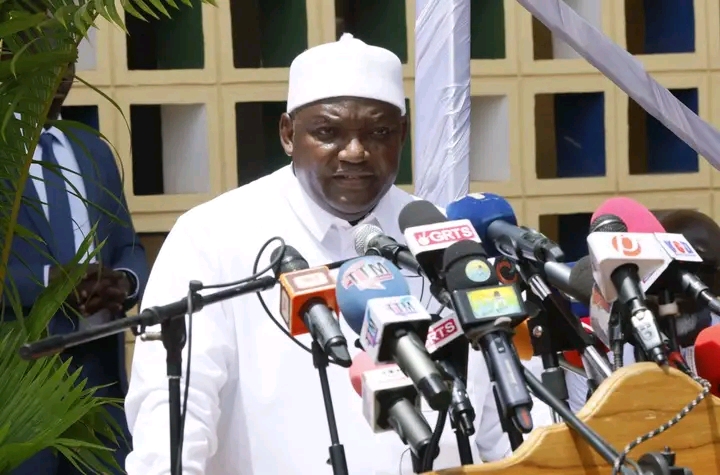
President Adama Barrow has declared that The Gambia will no longer depend on foreign countries to verify the safety of its food and medicines, as he commissioned the country’s first National Food and Drug Quality Control Laboratory.
Opening the facility in Brusubi, President Barrow said the development marks a decisive shift in how the country safeguards public health, insisting that all testing and certification will now be done locally.
“No longer will The Gambia rely solely on other countries to verify the safety of our medicines and food. We will test them here, certify them here, and protect the citizens and residents of our country,” he said.
The President described the laboratory as a “red-letter day” in the national health system, framing it as a cornerstone of his government’s development agenda under the National Development Plan.
He stressed that the ability to independently test food and pharmaceuticals is central to protecting citizens from harmful products, warning that delays in foreign testing previously exposed the country to serious risks.
“Sometimes we waited for weeks for results of samples tested abroad. Our citizens paid dearly for that arrangement, as delays often cost lives,” he noted.
Barrow said the new facility is equipped with modern technology capable of detecting harmful substances and bacteria in food and verifying the safety and effectiveness of medicines.
He also issued a strong message to businesses and importers, urging full compliance with national standards, and rejecting the idea that regulation should be seen as a burden.
“Regulations are not barriers to success, but bridges,” he said, adding that government will continue to work with manufacturers and importers to meet required standards.
The President warned that substandard food products and counterfeit medicines will no longer be tolerated, calling for stricter surveillance by regulatory agencies.
“From now on, we must remove all unsafe food items from our markets and fake medicines from our medical facilities,” he stated.
Barrow further indicated that the laboratory will be aligned with international accreditation systems and global regulatory networks, while staff will be trained to meet global standards.
He also acknowledged funding support from the World Bank and praised the Ministry of Health for implementing the project.
The commissioning of the laboratory is expected to significantly strengthen national capacity in food safety and pharmaceutical regulation, reducing reliance on external systems and tightening control over products entering the Gambian market.
By Adama Makasuba







Recent Comments