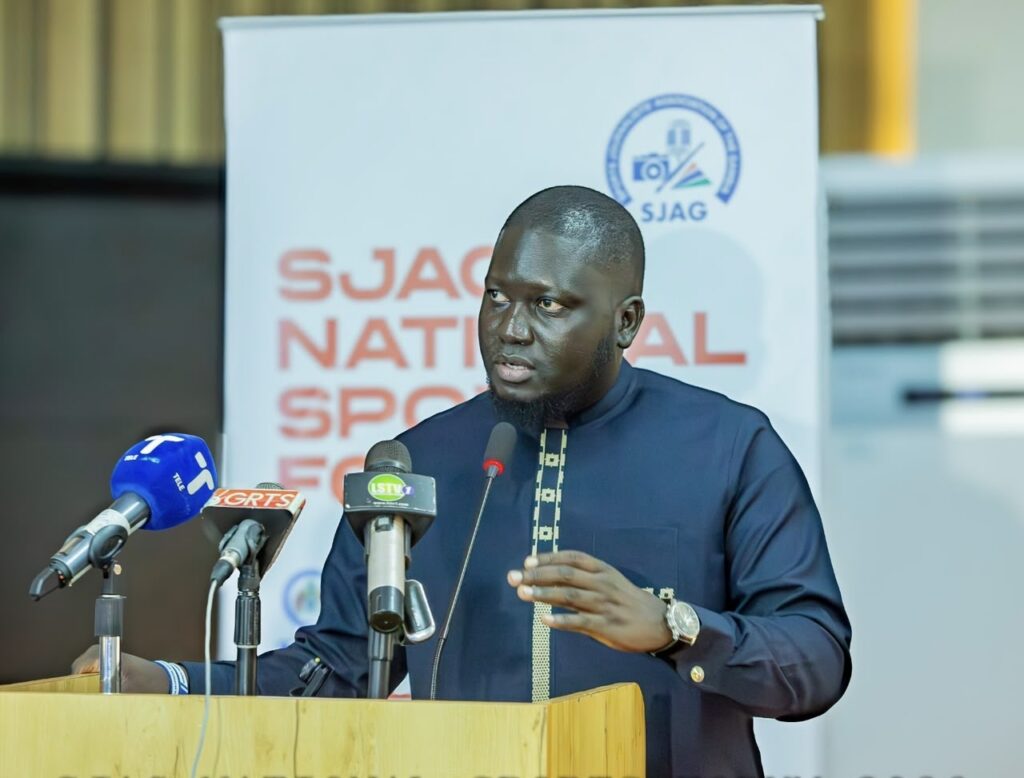
The Sports Journalists Association of The Gambia (SJAG) has declared that reporting sports is no longer enough, as it opened its first-ever National Sports Forum on Saturday at the Bakadaji Hotel, Kololi.
Declaring the forum open, SJAG President Omar Jarju said journalists must now help shape the environment that enables excellence.
The forum, held under the theme “Modernising Sports Funding and Infrastructure for Sustainable Development,” brought together the Ministry of Youth and Sports, the National Sports Council, presidents of national associations and federations, private-sector leaders, athletes, and the media.
Omar Jarju said Gambian talent is undeniable, from dusty community pitches in the provinces to school tracks in the Greater Banjul Area, but raw talent alone cannot compete against modern global standards.
“Talent requires fertile soil to grow. That soil is built on two non-negotiable pillars: modern infrastructure and sustainable funding,” he said.
He lamented that sport is too often treated as leisure or luxury in national budgets, with stadium renovations delayed and grassroots grants trimmed when economies tighten.
“Sport is not a drain on the national treasury. Properly funded and smartly built, sport is one of the highest-yielding investments a nation can make,” Omar Jarju stressed.
The SJAG President called for structural reform, including autonomous sports development funds, transparent accountability portals for federations, and public-private partnerships that incentivise corporate investment.
Omar cited the global sports market, valued at $480 billion in 2024 and projected to surpass $630 billion by 2028, and questioned why Africa, which contributes only 0.5%, cannot raise its share to 2.5%, 5% or even 10%.
Omar Jarju also insisted that greatness must begin in regions, schools and communities, with a protected percentage of funding going directly to community multi-sport courts, coaching education and equipment.
He pointed to The Gambia’s successful hosting of the CAVB Beach Volleyball Championship, WAFU Women Qualifiers and ECOWAS Wrestling Championships as proof that sport can drive economic development.
In his closing, the award-winning sports journalist challenged participants to speak boldly and commit to resolutions, saying November 28th, 2026 should be remembered as the day The Gambia stopped talking about potential and started building the future of its sports.



Recent Comments