A democracy is sustained not only by laws but also by symbols, rituals, and respect for institutions. The presidency is not a prize to be claimed but a public trust to be earned. From the lawyer’s robe in court to the candidate’s appearance before the electoral commission, societies communicate their values through conduct.
The presidency is not a casual errand. It is a constitutional pilgrimage. That is why lawyers dress differently when they enter a courtroom, and why serious candidates should approach nominations with evidence of preparation, not explanations for its absence.
There is honour in walking, honour in public transport, and honour in modest attire. Halifa Sallah and Sidia Jatta demonstrated that. Ousainou Darboe demonstrated the professionalism of a lawyer seeking the nation’s highest office.
Joseph Henry Joof’s second unsuccessful encounter with nomination requirements demonstrates something else entirely: that humility without preparation can become symbolism without substance. The authority of institutions rests not only on constitutions and statutes but also on the respect citizens and leaders show them. In the same way, a presidential nomination is more than paperwork. It is the first public demonstration of readiness for leadership.
A republic survives not merely through laws but through a culture of respect for institutions. Constitutions provide the framework, but civic conduct gives it life. When that culture weakens, public offices gradually lose their meaning, and institutions become little more than administrative buildings. Democracy then risks becoming performance rather than purpose. This is why the nomination of presidential candidates matters: it is one of the clearest tests of that respect.
The Independent Electoral Commission is not an ordinary government office. It is a constitutional body entrusted with one of democracy’s most sacred responsibilities: safeguarding the sovereign will of the Gambian people. Before the first ballot is cast, before the first campaign rally is held, and before a single vote is counted, the IEC becomes the gateway every presidential aspirant must pass through. That gateway deserves respect. Not because the law demands spectacle, but because democratic culture demands seriousness.
A presidential nomination is not a carnival. It is not a motorcade competition. It is not a test of wealth. The point is not how many vehicles accompany a candidate, how many supporters make noise outside the IEC, or how much money is spent on banners and publicity. Rather, it is about demonstrating preparedness, discipline, organisation, and respect for the constitutional process.
Across the democratic world, presidential nominations are treated with solemnity and significance. Candidates often appear surrounded by spouses, children, campaign strategists, legal advisers, party officials, religious leaders, community elders, and supporters. These are not merely political accessories or photo opportunities. They communicate organization, preparedness, legitimacy, and an appreciation of the gravity of the office being sought.
When Barack Obama formally launched his presidential campaign in Springfield, Illinois, he did so with family, supporters, and political allies gathered around him. When Joe Biden sought the presidency, his candidacy was visibly anchored by his wife, family members, advisers, and a disciplined campaign structure.
In Kenya, William Ruto’s presidential journey was marked by family, party officials, clergy, supporters, and campaign operatives. In Ghana, both Nana Akufo-Addo and John Mahama approached critical electoral milestones accompanied by party leadership, campaign teams, family members, and supporters. Whatever one thinks of these leaders politically, they all understood one thing: the presidency is larger than the individual seeking it. In The Gambia, we have our own examples.
In 1997, lawyer Ousainou Darboe appeared before the IEC with family, party executives, and supporters, dressed in a suit consistent with both the traditions of his profession and the dignity of the occasion. The suit itself neither qualified him for office nor made him a superior candidate. Yet it symbolised seriousness, preparedness, and respect for a constitutional institution.
Similarly, Halifa Sallah demonstrated another important lesson during the 2021 nomination process. No Gambian politician is more closely associated with personal simplicity than Halifa. He has spent decades cultivating an image of modest living, intellectual seriousness, and ideological consistency.
Yet when he appeared before the IEC, he did so in dignified traditional attire befitting the occasion. He did not need an expensive suit to project seriousness. He remained authentically Halifa Sallah while honoring the moment’s constitutional significance.
The same could be said of Sidia Jatta and the PDOIS tradition. Their approach has long emphasized modesty over spectacle. Yet modesty does not mean indifference to occasion. Historical evidence and witnesses show that Halifa Sallah and Sidia Jatta walked from the PDOIS bureau in Churchill’s Town to the IEC with party officials, supporters and militants, and that walk illustrated the distinction perfectly. There was no display of wealth. There was no elaborate convoy. No one tried to manufacture grandeur.
Yet there was purpose. There was organisation. There was discipline. Most importantly, there was respect for the constitutional moment. The lesson is simple. Simplicity is not the same as casualness. Humility is not the same as informality. Modesty is not the same as carelessness.
One can be simple and still be presidential. One can be humble and still be dignified. One can reject extravagance while embracing seriousness. This is why the controversy surrounding former Attorney General and Senior Counsel Joseph Henry Joof cannot be reduced to a superficial debate about clothing. The issue runs much deeper: it is about preparedness, symbolism, and judgment.
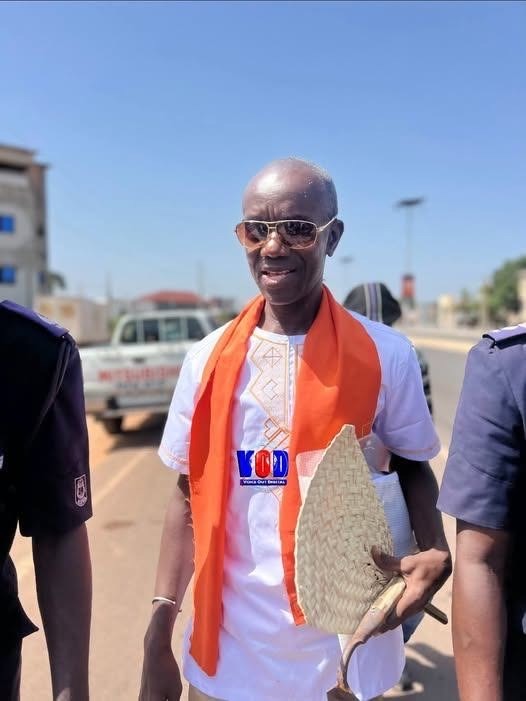
The concern is not merely about his attire, his mode of transportation, or his personal style. The real concern is preparedness, symbolism, and judgment. The symbolism of arriving alone in a taxi deserves reflection, though not for the reasons some might assume. There is nothing dishonorable about a taxi. There is dignity in public transportation. There is dignity in modest means. The presidency should never become a competition of luxury vehicles. But politics is also the language of symbols. The question is not whether Joseph Joof arrived in a taxi. The question is what message he intended to send by arriving alone.
Presidential nominations are rarely solitary exercises. Across the world, candidates usually appear alongside family members, campaign officials, legal advisers, political associates, religious leaders, supporters, and well-wishers.
Their presence signals that a candidacy possesses structure, organisation, and support. It communicates that seeking the presidency is not a personal adventure but a collective undertaking. What message was being projected? Humility? Simplicity? Independence?
If so, those virtues could have been communicated without diminishing the gravity of the occasion. The issue becomes even more significant when viewed alongside the question of preparedness. This was not Mr. Joof’s first attempt to seek the presidency.
In 2021, the IEC rejected his nomination after he failed to meet the prescribed requirements. His subsequent legal challenge did not restore his candidacy. That experience should have made him one of the most prepared presidential aspirants in Gambian political history.
No one should have understood the importance of compliance better. No one should have appreciated the consequences of non-compliance more fully. No one should have arrived more prepared. Yet Gambians once again found themselves discussing whether the requirements had been adequately fulfilled. The irony is difficult to miss.
This is not an ordinary aspirant unfamiliar with legal procedure. This is a former Attorney General and Minister of Justice. A former President of the Gambia Bar Association. A former leader within the West African legal community. A Senior Counsel whose professional life has been devoted to interpreting laws, advising clients, and navigating legal processes. If anyone should understand compliance, it should be a lawyer of such standing.
One of the most remarkable moments of the 2026 nomination process involved Mr. Joof’s proposal that properties worth millions of dalasis be accepted in place of the required one-million-dalasi nomination deposit. He advanced a legal interpretation and proposed assigning valuable properties to satisfy the requirement.
The problem was straightforward. The law was clear. The requirement was not property. The requirement was not collateral. The requirement was not assignment. The requirement was a monetary deposit. Election officials repeatedly reminded him that the issue was compliance, not interpretation.
That moment revealed something deeper. A presidential nomination is not an examination in constitutional theory. It is not a courtroom debate. It is not an intellectual exercise. It is a test of preparedness. And preparedness begins with meeting the requirements exactly as they exist, not as one wishes them to exist.
That is why the issue ultimately transcends Joseph Joof himself. It reflects a wider tendency in Gambian politics where aspiration is sometimes mistaken for readiness. We hear elaborate visions, promises, and declarations of what candidates will accomplish during their first hundred days in office before they have successfully demonstrated mastery of the first day of the nomination process.
This is a growing feature of what I have elsewhere described as the politics of Sosalaaso, Tefyengal, and Tangal Cheeb, where symbolism sometimes outruns substance, rhetoric outruns organization, and ambition outruns preparation. A lawyer appearing before the Supreme Court understands that institutions matter. A journalist attending a state function understands that protocol matters. A diplomat understands that ceremony matters. A religious leader understands that sacred occasions matter.
These conventions do not exist because people are obsessed with appearances. They exist because institutions derive authority not only from law but also from culture, symbolism, and collective respect. So too does the IEC. The law may not prescribe a dress code for presidential aspirants. Nor should it.
Democracy must never become a contest of expensive clothing, luxury vehicles, or political extravagance. Yet democracy requires something far more important than a dress code. It requires seriousness. It requires preparation. It requires respect.
Ultimately, the enduring question is not whether Joseph Henry Joof wore a casual outfit or rode in a taxi. The enduring question is whether his candidacy reflected the preparation, organization, institutional respect, and attention to detail expected of a former Attorney General seeking the highest office in the Republic after already failing to satisfy nomination requirements once before.
For the presidency begins long before inauguration day. It begins with preparation. It begins with discipline. It begins with respect for institutions. And it begins with understanding that the office being sought is not a personal platform but a national trust.
A nation does not hand over its future merely to the most eloquent aspirant, the most celebrated lawyer, or the most accomplished public figure. It entrusts that future to those who demonstrate judgment, organization, discipline, and respect for the rules that bind us together. The IEC is more than a building. It is a constitutional guardian of our democracy. The nomination process is more than paperwork. It is the first practical demonstration of a candidate’s readiness to govern.
If a presidential aspirant cannot convincingly clear that first test, citizens are entitled to question readiness for the far greater responsibilities that await beyond it. The presidency is not won by ambition alone. It is earned through preparation, discipline, and an unmistakable appreciation for the institutions that sustain the Republic.
In the end, the most persuasive campaign message is not delivered in a speech, a slogan, or a legal argument. It is delivered through conduct. And on nomination day, conduct is often the first glimpse voters receive of the leadership that may one day govern them.
Perhaps the greatest irony is that Joseph Henry Joof’s story was never really about a taxi, a shirt, or an appearance before the IEC. Taxis are honourable. Public transport is honourable. Simplicity is honourable. The real issue is that he appeared to mistake those symbols for the substance of leadership.
Halifa Sallah and Sidia Jatta showed that one can walk to the IEC and still project preparedness, discipline, and respect for the office being sought. Ousainou Darboe showed that professional appearance can symbolise reverence for constitutional institutions. But no symbol, however powerful, can substitute for readiness.
A former Attorney General who had already experienced rejection in 2021 should have arrived at nomination not with explanations, interpretations, and unresolved requirements, but with every legal obligation fulfilled beyond question. In the end, democracies do not elect symbols; they entrust power to people.
And the first duty of anyone asking to lead a nation is to show he is prepared to lead himself by the rules that bind every citizen equally. That is why nomination day matters. It is not the end of the presidential journey. It is the first test of whether a candidate truly understands the weight of the office he seeks.
By Alagi Yorro Jallow







Recent Comments