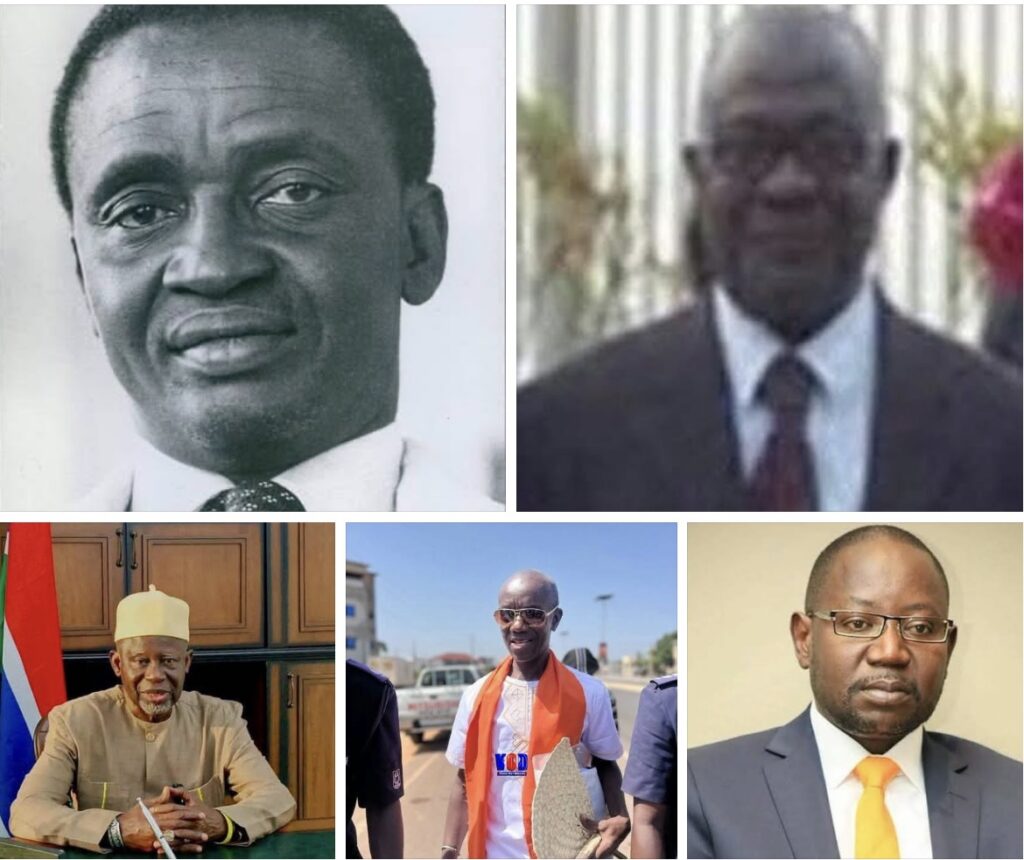
This commentary is not a critique of the legal profession. On the contrary, it argues that a profession producing some of the country’s brightest minds has often failed to convert legal excellence into presidential success.
Its central thesis is that legal expertise alone does not produce presidential victory; political organisation and democratic legitimacy do. This paper focuses on that relationship in The Gambia.
The legal profession teaches how to interpret constitutions, win arguments, and persuade judges. Democracy demands something different: the ability to persuade ordinary citizens, build coalitions, and turn ideas into movements. That contrast helps explain a recurring question in Gambian politics: why have so many of the nation’s “learned” men struggled to win the electorate’s confidence, while lawyer-politicians such as Nelson Mandela, Abdoulaye Wade have succeeded elsewhere.
Gambian politics has an irony at its heart. Few professional titles command more respect than that of a lawyer. In courts, lawyers defend liberty, interpret constitutions, challenge governments, and protect citizens from injustice.
They are trained to think rigorously, argue persuasively, and navigate the complex architecture of law and governance. Society therefore assumes that the lawyer should possess the intellectual tools for leadership. If it assesses the intellectual tools for leadership, it should be the lawyer.
Yet history tells a different story. For more than seven decades, The Gambia has produced distinguished legal minds, brilliant advocates, respected attorneys general, accomplished jurists, and formidable courtroom strategists.
Many have crossed from the courts into politics, carrying impressive credentials and public respect. Still, election after election, the presidency has proven remarkably elusive. The question remains: why do lawyers who persuade judges struggle to persuade voters?
Why do men and women celebrated as “learned” struggle to convince the electorate that they deserve the highest office in the land? The answer lies in a fundamental misunderstanding that has shaped the political journeys of many lawyer-politicians.
The courtroom and the ballot box may both involve persuasion, but they operate according to entirely different rules. The central point is simple: the courtroom rewards logic, while politics rewards trust, connection, and coalition-building. That distinction is the heart of the Gambian lawyer’s paradox.
No discussion of lawyers in Gambian politics can begin anywhere other than with Pierre Sarr N’Jie, the towering legal and political figure of the late colonial era. Educated in Britain and trained at Lincoln’s Inn, Pierre became Chief Minister and leader of the United Party, standing at the center of the country’s constitutional transition toward self-government.
Even today, he remains arguably the most politically successful lawyer in Gambian history. Yet his story also reveals the limits of legal brilliance in democratic politics. He possessed intellect, eloquence, and constitutional sophistication, but he confronted a rival who understood something different and perhaps more important.
Sir Dawda Jawara understood people. He built coalitions where Pierre built arguments. He cultivated villages where Pierre cultivated institutions. He created electoral networks while Pierre focused on constitutional politics. As a result, the United Party gradually declined, while Jawara’s People’s Progressive Party became the dominant force of the First Republic.
The first great lawyer-politician had discovered a lesson that would later confront many others: elections are not won by legal reasoning alone.
If Pierre Sarr N’Jie was the lawyer who came closest to power, Pap Cheyassin Secka remains one of the most fascinating unrealised possibilities in Gambian political history. Few questioned his intellectual quality, patriotism, or legal competence. Yet despite commanding considerable respect, his National Liberation Party never evolved into a major national political force.
The explanation may be uncomfortable, but it is important: Democracy is not an examination in which citizens grade candidates by the quality of their constitutional arguments. Citizens vote according to trust, relationships, hope, identity, and confidence in leadership.
A lawyer may persuade a judge through logic, but a politician must persuade fishermen in Kartong, farmers in Fulladu, traders in Serekunda, youths in Brikama, and civil servants in Banjul. That requires a different skill set. Pap Cheyassin Secka’s story reminds us that brilliance can earn admiration without necessarily producing electoral momentum.
Ousainou Darboe’s case is more complicated. Measured narrowly by presidential victories, Darboe has been unsuccessful. Yet measured by political endurance and institution-building, he may be one of the Second Republic’s most successful politicians.
The UDP that he led in 1996 survived repression, arrests, imprisonment, electoral defeats, and leadership challenges. Few opposition movements in Africa have demonstrated comparable durability. In that sense, Darboe succeeded where many others failed. He built an institution.
History may ultimately remember Ousainou Darboe less as a presidential candidate and more as the architect of modern opposition politics in The Gambia. Yet his experience also reinforces the central paradox. Building a durable opposition movement and winning the presidency are not necessarily the same achievement. One requires resilience. The other requires assembling a national majority.
The contrast with other African democracies is revealing. In Senegal, Wade spent decades in opposition before finally becoming president. His success was not the product of legal qualifications alone. He built political networks, cultivated grassroots support, forged alliances, and became a symbol of democratic alternation.
South Africa offers an even more compelling example. Nelson Mandela was a lawyer by training, but history remembers him as the embodiment of national liberation, reconciliation, and democratic renewal.
Ghana’s experience is equally instructive. Edward Akufo-Addo, a distinguished lawyer and statesman, served as Ghana’s president.
Decades later, Nana Addo Dankwa Akufo-Addo, one of Ghana’s most prominent lawyers and a former Attorney-General, successfully navigated the long journey to the presidency. Ghana also produced John Evans Atta Mills, a legal scholar and tax law expert who rose to the highest office through coalition-building and political organisation.
The lesson from these countries is unmistakable: their lawyer-presidents were not elected because they were lawyers. They were elected because they became movements. They became symbols. They convinced citizens that they represented something larger than themselves. That is the broader point of this discussion and the clearest answer to the Gambian paradox.
The experiences of Ahmed Fatty and Joseph Henry Joof further illuminate the challenge. Both possess considerable intelligence and political awareness. Both are articulate and knowledgeable. Yet politics demands something beyond expertise. Ideas must become organisation. Knowledge must become networks. Arguments must become movements. Professional achievement commands respect, but respect alone cannot fill ballot boxes. That is one of the hardest lessons in democratic politics.
This brings us to Lamin J. Darbo, perhaps the most intriguing new chapter in this story. Unlike previous generations, he enters politics in an era of social media, democratic openness, political fragmentation, and growing public demand for alternatives. That creates opportunities, but it also creates illusions.
Visibility can be mistaken for popularity. Popularity can be mistaken for support. Support can be mistaken for organization. The challenge before Lamin J. Darbo is not whether he is intelligent enough, but whether he can turn attention into lasting political strength.
Most Gambians already assume lawyers are intelligent. The challenge is whether he can avoid the historical trap that has ensnared so many lawyer-politicians before him. Can he build a movement instead of merely advancing arguments? Can he connect with ordinary citizens as effectively as he connects with ideas? Can he transform professional credibility into political legitimacy? Those questions remain unanswered, but history suggests that they are the questions that truly matter.
Perhaps the Gambian lawyer’s paradox is not really about lawyers at all. It is about the difference between being respected and being trusted. From Pierre Sarr N’Jie to Pap Cheyassin Secka, from Ousainou Darboe to Ahmed Fatty, Joseph Henry Joof, and now Lamin J. Darbo, the recurring challenge has been the same: transforming professional authority into popular legitimacy. That is the central lesson of this discussion.
The examples of Mandela, Wade, Akufo-Addo, and Obama demonstrate that legal training is not a barrier to political success. Indeed, it can be a tremendous advantage. But those leaders succeeded only after they ceased being viewed primarily as lawyers and became symbols of larger national aspirations. That may be the enduring lesson for Gambian lawyer-politicians: the law teaches one how to interpret society’s rules, but politics requires one to inspire society itself.
Politics demands the ability to understand society’s hopes. The law produces learned counsel. Democracy produces leaders. The two occasionally meet in the same person. More often they do not.
And until Gambian lawyers learn to turn legal brilliance into enduring political movements, the presidency may remain beyond the reach of many of the nation’s brightest legal minds. For in every democracy, judges deliver judgments, but only the people deliver power.




Recent Comments