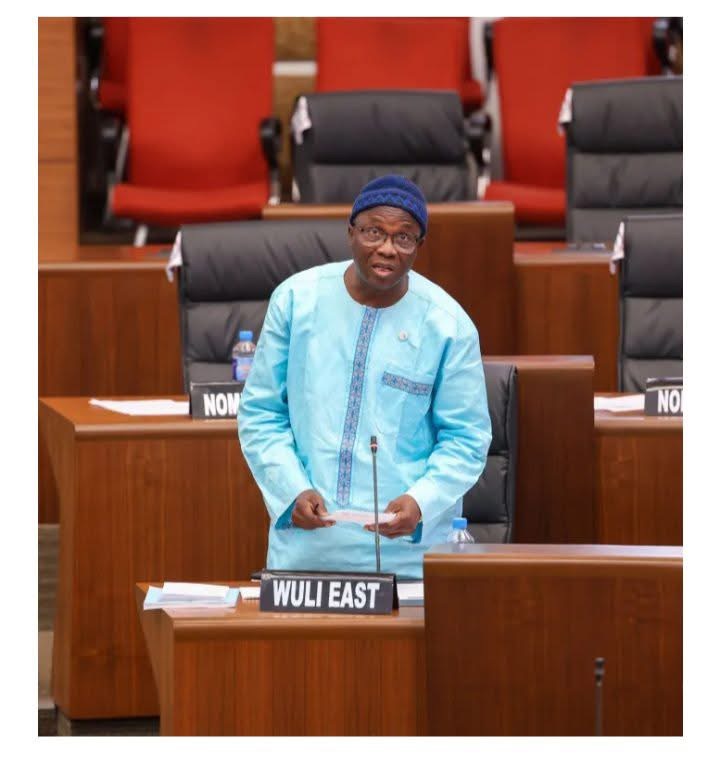
There are political arguments that merely enter the room, and there are arguments that kick down the door. Honourable Suwaibou Touray’s call to abolish nominated members from The Gambia’s National Assembly is loud, dramatic, and dangerously uninformed. It is the kind of argument that dazzles with certainty but collapses under the weight of constitutional memory.
It is a proposal that mistakes electoral arithmetic for democratic wisdom, and in doing so, threatens to erase the very minorities whose silence already haunts our Parliament.
For what Touray calls “democratic purity” has produced a National Assembly that is anything but representative. Today, for the first time in our republican history, the Gambian Parliament sits without a single Christian member, a moral and constitutional failure in a country that once prided itself on religious pluralism.
It sits without youth representation, without disability representation, without the ethnic breadth that once gave our legislature its legitimacy. It sits as a chamber shaped not by national diversity but by the narrow gate of electoral privilege.
This is the crisis Touray should have confronted. This is the democratic wound he should have exposed. Instead, he proposes to abolish the only constitutional mechanism capable of restoring balance to the nominated seats designed to protect minorities, elevate expertise, and correct the blind spots of electoral politics.
To abolish nominated members now, at the very moment when minorities have vanished from the Assembly, is not reform. It is erasure. It is the triumph of political amnesia over constitutional wisdom.
It is the dangerous illusion that democracy is nothing more than the rule of the majority, even when the majority excludes half the nation.
Democracy is not a headcount. Democracy is the protection of those who cannot win the headcount.
And any argument that forgets this is not a democratic argument at all.
The Gambia’s democracy, marked by fragility and inequality, requires more than just elections to ensure genuine representation. At times, a single argument in a nation’s political dialogue can reveal significant misunderstandings of constitutional principles.
Honourable Suwaibou Touray’s proposition to eliminate nominated members from the National Assembly exemplifies this. In such a moment, political fervor often overshadows the necessary historical context and the careful research that should underpin our decisions.
When a senior opposition figure suggests a remedy that might worsen our challenges, it calls for critical reassessment.
In our national conversations, we sometimes let emotion cloud historical insights and allow rhetoric to overshadow constitutional design.
Experienced politicians must recognize that The Gambia does not exist in a vacuum; it is part of the global democratic landscape.
Touray asserts that only elected members should serve in Parliament, arguing that nominated members diminish popular sovereignty and represent a vestige of colonialism incompatible with a true republic.
Though his stance is delivered with boldness and conviction, it ultimately falters when measured against our historical realities, comparative constitutional practices, and the specific needs of Gambian politics.
His argument, while persuasive on the surface, lacks a nuanced understanding of our democratic fabric and its complexities.
Nominated members were never a colonial accident. They are a deliberate democratic safeguard retained by the framers of both Republics because elections produce majorities, not diversity.
Elections reward those with resources, networks, and social privilege, not necessarily those representing the nation’s minorities, women, youth, Christians, persons with disabilities, or those with needed expertise. That is why nominated members exist: to complete democracy, not weaken it.
Today, The Gambia’s National Assembly stands as a painful example of what happens when electoral politics is left alone to determine representation.
In the 2022 parliamentary elections, only three women were directly elected out of fifty‑three constituencies. Women constitute more than half of the population, yet they hold barely 8.6 percent of parliamentary seats.
Without the two nominated women, the Assembly would be even more male‑dominated than it already is. This is not a theoretical imbalance; it is a structural failure.
Even more troubling, the current National Assembly has no Christian member. For decades, the Assembly had at least one Christian voice, elected or nominated. Today, Christians make up about five percent of the population, but they have no presence in the legislature.
This is not only embarrassing; it is dangerous. It shows a step back from the pluralism that has helped define Gambian politics since independence.
The Assembly lacks youth and disability representation, ethnic diversity beyond dominant groups, and the professional voices—legal, medical, educational, and economic —that nominated seats were designed to bring in.
These are the crises Honourable Touray should lament. Instead, he proposes abolishing the very mechanism to correct them.
Honourable Touray’s claim that nominated members are merely a colonial leftover lacks historical weight. If unelected representation were truly undemocratic, then the United Kingdom, the very example he cites, would be the biggest offender.
The British Parliament still includes ninety‑two hereditary, unelected members in the House of Lords, a thousand‑year‑old body only now being gradually reformed.
Canada’s entire Senate is appointed. Ireland’s Prime Minister picks eleven members for the Seanad. Singapore appoints eleven non‑partisan Nominated Members of Parliament to bring independent expertise into the legislature.
Jordan reserves seats for Christians, women, Circassians, and Bedouins. Countries like Bangladesh, India, and Rwanda also have systems in place. Rwanda’s Chamber of Deputies, for example, reserves 24 seats for women through a quota system.
Many nations use quotas and reserved seats to address historical exclusion and ensure representation for women and other groups.
Honourable Touray’s proposal risks harming the very groups The Gambia wants to help. For example, a 2026 bill calls for 14 reserved seats for women, showing that elections alone can’t fix gender inequality. Rwanda, which leads in women’s representation, didn’t reach 60% female parliament by luck; it used affirmative action and quotas.
Touray’s ideas would move The Gambia backward.
If we followed Touray’s logic everywhere, half the Commonwealth and many stable democracies would seem illegitimate. But they are not. They recognize that representation is based on constitutional design, not just numbers.
The Gambia’s constitutional framers understood these points. They created nominated seats to protect minorities, add expertise, balance differences, and keep the nation united.
The issue is not with having nominated seats. The issue is how presidents have used them, often choosing loyalists instead of seeking national balance. Still, if a tool is used incorrectly, we should fix the use, not destroy the principle.
Touray also criticises that the Speaker and Deputy Speaker are unelected, but this ignores Gambian tradition. Since the First Republic, Speakers have often come from outside elected members to maintain neutrality and professionalism and to stay away from constituency politics. Saying the Speaker must be elected is not a rule, just a choice. Debating this is a separate issue from whether nominated members should exist.
The real risk in Hon.Touray’s proposal is that it would reduce representation at a time when The Gambia needs more, not less. Getting rid of nominated seats would silence minorities, erase diversity, and deepen the control of those in power. It would leave Christians voiceless, women even more marginalised, youth excluded, people with disabilities invisible, and professional expertise missing. Instead of protecting our diversity, the Assembly would become a reflection of our inequalities.
A democracy that fails to protect its minorities doesn’t live up to its name. The framers of our Constitution knew this, and so do many countries—except Honourable Touray, who seems to ignore it. Touray’s stance is majoritarian, not democratic.
Elections pick winners, but constitutions are meant to protect everyone else. A Parliament made up only of those who can win in a patriarchal, patronage‑driven system isn’t truly representative; it simply reflects our inequalities. The framers understood this. Many nations understand this. Only Touray pretends not to.
The real issue isn’t whether nominated members should exist, but whether they should finally fulfill their intended purpose. That means having clear nomination criteria, public vetting, gender and minority quotas, and a constitutional rule requiring at least one nominee to represent the Christian community, one to represent people with disabilities, and one to represent youth.
It also calls for a commitment to professionalism, independence, and national balance. Getting rid of them isn’t reform, it’s a step backward.
Getting rid of nominated seats does not make democracy stronger; it makes it weaker. It would silence minorities, reduce diversity, and give more power to those already in charge. The real question is whether nominated members will finally fulfill their purpose. A democracy that cannot protect minorities does not deserve its name. As the Mandinka saying goes, “A community is strengthened not by the loudest voices, but by the inclusion of the quietest.”
The Gambia needs to choose inclusion, reform, and remember its constitutional principles, not erase them.
By Alagi Yorro Jallow






Recent Comments