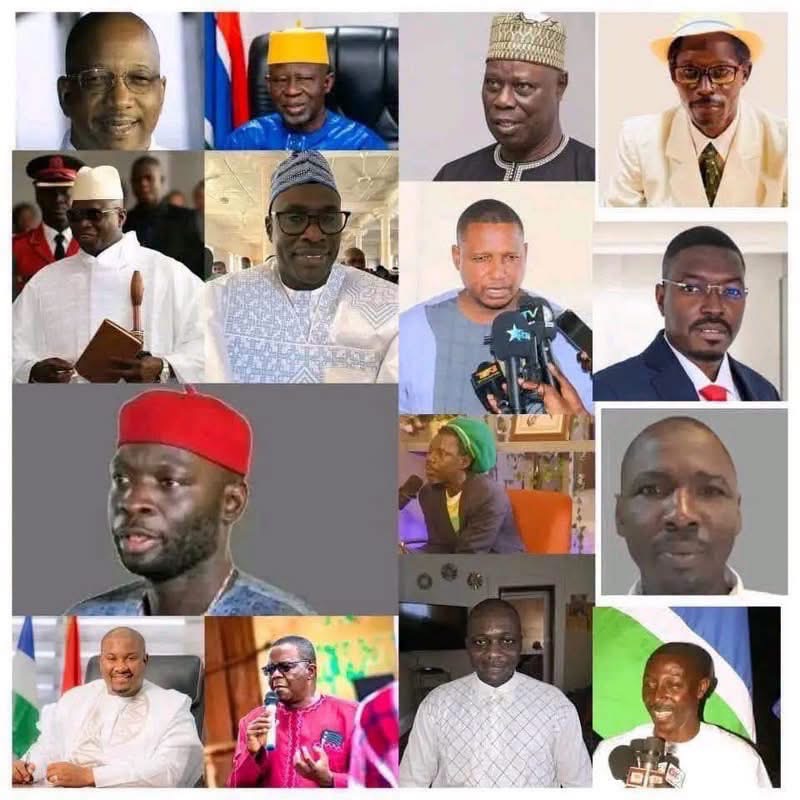
As nominations open from November 3 to November 14 for the December 5, 2026 presidential election, The Gambia finds itself at a democratic crossroads. The IEC’s announcement that 1,146,474 voters have been registered and that twenty-seven presidential aspirants have collected nomination forms is not merely an electoral update.
It shows a political system undergoing profound transformation. Beneath the numbers lies a larger story of coalition politics, electoral fragmentation, growing demands for diaspora voting, and an increasingly competitive political marketplace in which established parties, emerging alliances, sosalaaso movements, taf yengal formations, and tangal cheeb politicians all compete for influence. The question before the country is no longer whether democracy exists. It is whether our institutions are prepared for the democracy we are becoming.
The latest announcement from the Independent Electoral Commission deserves to be read not merely as an administrative update but as a political diagnosis of where Gambian democracy now stands.
According to the IEC, 1,146,474 voters are registered ahead of the December 5, 2026 presidential election. The Commission has also confirmed that twenty-seven presidential aspirants have collected nomination forms, while the official nomination process begins on November 3 and concludes on November 14.
Whether all twenty-seven ultimately qualify is almost beside the point. Some will fail to satisfy the legal requirements. Some will withdraw. Others will discover that coalition politics offers greater rewards than electoral defeat. By the time nominations close, the field will almost certainly be smaller than it appears today. Yet even if the number is substantially reduced, the announcement’s significance remains unchanged. The announcement reveals a democracy undergoing structural transformation.
A political system once dominated by a relatively small number of actors is becoming more crowded, more fragmented, more competitive, and increasingly coalition-driven. Presidential ambition is no longer confined to a narrow political class. Political parties, civic formations, independent aspirants, and emerging movements increasingly view national leadership as an attainable democratic objective. That development should be welcomed.
A democracy is healthier when more citizens believe they have a stake in shaping its future. The Constitution does not reserve public office for a privileged few. It allows qualified citizens to place themselves before the electorate and seek a mandate from the people.
Yet democratic expansion inevitably generates new pressures. The question therefore becomes unavoidable. Are our electoral institutions evolving as fast as our democracy? The immediate challenge is practical.
The Gambian electoral system remains one of the most distinctive and admired democratic innovations on the African continent. The marble voting system has enhanced accessibility, minimized invalid votes, and earned public trust over several generations.
But a presidential contest involving twenty-seven aspirants would place unprecedented demands on that same system.
Every polling station would potentially require a corresponding increase in ballot drums, candidate identification materials, logistical arrangements, security procedures, and administrative oversight. Polling stations would become more crowded. Election management would become more complex. Voters would face a level of choice rarely encountered in Gambian electoral history.
The challenge is manageable. But it is also revealing, for the real significance of twenty-seven aspirants extends far beyond the mechanics of voting. It points to the ongoing transformation of Gambian politics itself. The 2026 election increasingly revolves around three major centers of political gravity.
The first is the governing NPP-led coalition under President Adama Barrow. The second is the UDP-led opposition alliance, which continues to position itself as the government’s principal alternative. The third is the emerging UNITE 2026 coalition associated with Talib Ahmed Bensouda, which seeks to establish itself as a new political centre and a fresh vehicle for national leadership.
Around these three blocs circulate a familiar constellation of smaller parties, “Sosalasso, and tef-yengal” briefcase political parties and movements, independent aspirants, breakaway factions, civic formations, pressure groups, sosalaaso movements, tef yengal alliances, and tangal cheeb politicians whose political significance often exceeds their electoral strength. This is where electoral politics intersects with political entrepreneurship.
Not every aspirant enters a presidential race expecting to become president. Some seek visibility. Some seek leverage. Some seek relevance. Some seek future cabinet appointments. Some seek admission into larger coalitions. Some seek endorsement deals.
Some seek bargaining power in the negotiations that inevitably accompany fragmented political contests. In other words, not every presidential campaign is truly a presidential campaign. Some are opening bids in a broader political marketplace whose most consequential transactions frequently occur away from the campaign stage and long before ballots are cast. This phenomenon is not unique to The Gambia.
Across democratic systems, smaller political actors often discover that influence can be acquired through negotiation rather than victory. Electoral strength is only one form of political capital. Strategic positioning, coalition value, and bargaining power can sometimes matter just as much.
Yet this reality presents voters with an increasingly difficult task. The challenge is no longer merely identifying who can win. The challenge is identifying who intends to govern. The emergence of twenty-seven aspirants therefore tells two stories simultaneously. One is a story of democratic success. The other is a story of political fragmentation. More Gambians are exercising their constitutional right to compete for power.
Yet Gambian politics increasingly resembles a complex ecosystem of shifting alliances, temporary partnerships, strategic calculations, and fluid political identities. The multiplication of candidates does not necessarily signify a multiplication of political visions.
Indeed, the opposite may sometimes be true. A crowded field can obscure political choices rather than clarify them. This reality raises another constitutional issue that deserves serious reflection. Suppose twenty-seven candidates were eventually nominated and votes were scattered across a highly fragmented field.
Under the current constitutional framework, a candidate could potentially secure the presidency with a relatively modest share of the national vote, provided that share exceeds that of every other contestant. Such an outcome would be entirely legal.
But legality and legitimacy are not always identical concepts. A victory secured amid intense fragmentation would inevitably provoke questions about mandate, representation, and the degree of public consensus underlying executive authority.
Many democracies facing similar conditions have adopted runoff systems designed to ensure the eventual winner commands majority support. The Gambia follows a different constitutional arrangement.
Nevertheless, a crowded electoral field offers a legitimate opportunity to reflect on whether future constitutional reform discussions should revisit the relationship between electoral victory and democratic legitimacy. This is not an argument for immediate reform. It is an argument for democratic foresight.
Constitutions are not designed only for present realities. They are designed to anticipate future challenges. The discussion becomes even more consequential when viewed alongside the unresolved question of diaspora voting. For years, Gambians living abroad have correctly argued that citizenship should not terminate at the airport.
The Gambian diaspora contributes enormously to the national economy through remittances, investment, professional expertise, and community development. Their economic contribution to national life is undeniable. Their emotional and political attachment to the country remains profound.
The democratic case for diaspora voting has therefore become increasingly difficult to ignore. Yet introducing diaspora voting alongside an increasingly fragmented electoral landscape would present significant logistical and administrative challenges.
A voting system originally developed for a smaller electorate, fewer political parties, and exclusive domestic participation would face entirely new demands. Again, this does not mean the challenge is insurmountable. It simply means that serious nations periodically review whether their institutions remain suitable for changing political realities.
Indeed, successful institutions often require adaptation precisely because they have succeeded. No democratic innovation should be exempt from periodic scrutiny. Not because it has failed.But because the society it serves has changed.
The significance of the IEC announcement therefore lies not in the number twenty-seven. That figure may rise. It may fall. It may shrink considerably by the close of nominations on November 14. The significance lies elsewhere. It lies in the fact that Gambian democracy is entering a phase for which many of its institutions were never originally designed.
An electorate of more than 1.14 million voters.Three competing coalition blocs. Persistent demands for diaspora participation. Increasing political fragmentation. A growing political marketplace populated by established parties, emerging coalitions, sosalaaso formations, tef yengal alliances, and tangal cheeb politicians navigating the space between principle and opportunity.
These are not temporary electoral curiosities. They signal a fundamental transition in the country’s democratic evolution. The real question before Gambians, then, is not whether twenty-seven aspirants can fit onto a ballot. Nor is it whether additional ballot drums can fit inside a polling station. Those are administrative questions.
The larger question is whether the constitutional architecture, electoral arrangements, and political culture inherited from an earlier democratic era are sufficiently prepared for an increasingly competitive, fragmented, coalition-driven, and globally connected political community.
The 2026 election will undoubtedly produce a president. But that is not the most important issue before the country. The more important question is whether The Gambia is prepared for the democracy that is beginning to emerge. For what the IEC figures reveal is not merely the scale of an election.
This election reveals the arrival of a new political era. An era in which coalition politics may matter as much as party politics.An era in which influence may increasingly be negotiated rather than won outright.An era in which institutions designed for simplicity must confront complexity. An era in which citizens’ democratic aspirations may outgrow the institutional assumptions of the past.
The challenge before Gambians is therefore not simply to choose a president. It is to decide what kind of democratic system should govern the republic in the decades ahead. Because the most consequential question raised by the nomination process beginning tomorrow is not who will eventually emerge victorious on December 5, it is whether the institutions that count our votes, structure our politics, and shape our democracy are evolving quickly enough to keep pace with the nation we are becoming.
By Alagi Yorro Jallow







Recent Comments