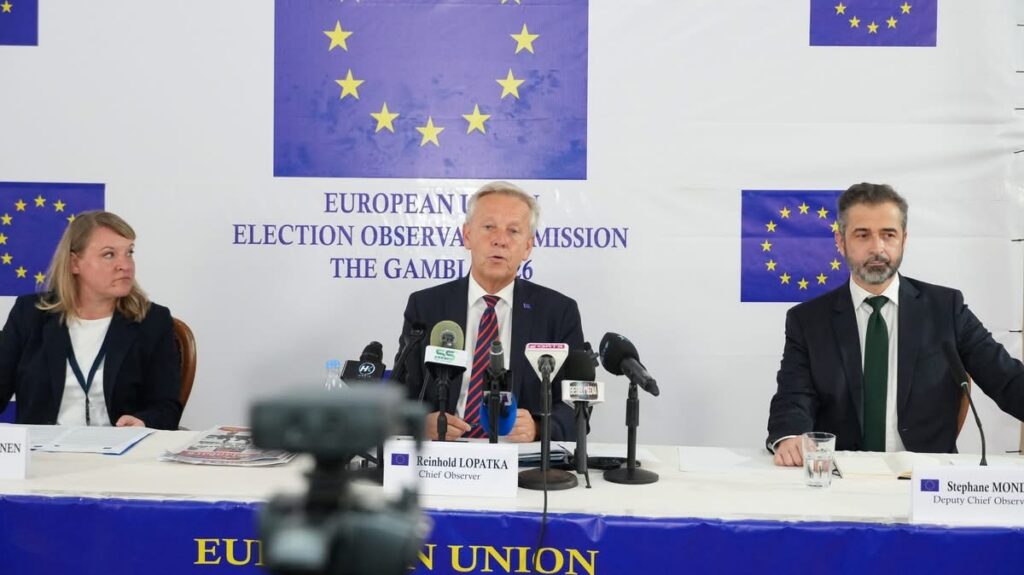
The European Union Election Observation Mission (EU EOM) has deployed 16 long-term observers across The Gambia as part of its monitoring of the December 5, 2026 presidential election, with the mission saying it will assess the electoral process from campaigning through voting, counting and the resolution of electoral disputes.
The observers, drawn from 15 European Union member states and Switzerland, were deployed on Thursday, November 5, joining an eight-member core team that arrived in the country on October 21.
The mission’s Chief Observer, Reinhold Lopatka, announced the deployment during a press conference at Ocean Bay Hotel in Bakau, where he formally launched the EU’s observation mission for the presidential election.
He said the mission would assess the election against Gambian electoral laws and international and regional standards and commitments on democratic elections.
“The 2026 presidential election is an opportunity for The Gambia to continue to strengthen its democracy,” Mr Lopatka said, adding that the mission’s presence throughout the country was intended to contribute to an inclusive, credible and transparent electoral process.
Shortly before election day, the mission will be reinforced by 20 short-term observers, a seven-member delegation of the European Parliament and locally recruited observers from EU member states, partner countries and diplomatic missions accredited to The Gambia.
The EU mission is expected to remain in the country until December 21, allowing it to observe the counting process and the handling of electoral disputes after polling.
Mr Lopatka said the mission would also monitor the conduct of political actors, traditional and online media, television and social media platforms as part of its assessment.
Responding to questions about how the mission would assess transparency, fairness and credibility, he said its approach would combine media monitoring, engagement with political parties and consultations with civil society and other stakeholders.
He welcomed the involvement of Gambian civil society organisations and domestic election observers, saying their participation demonstrated interest in strengthening democratic processes.
On the preparedness of the Independent Electoral Commission (IEC), Mr Lopatka said he was convinced that the electoral body was ready to conduct the presidential election, citing its manpower and experience.
“I am fully convinced that they are prepared for these elections. They have the manpower, they have the experience. Yes, it’s timely, but I am convinced that they can manage it,” he said.
The Chief Observer also stressed the importance of peaceful elections, saying political leaders, government institutions, security agencies and the electoral commission all had responsibilities in preventing electoral violence.
He warned that the growing influence of social media had introduced additional challenges to electoral processes, particularly by making it easier to spread hate speech.
“With social media it is much easier, for example, to use hate speech,” he said, adding that stakeholders needed to remain alert to developments that could lead to tensions and violence.
On media freedom, Mr Lopatka referred to feedback from Gambian journalists who told the mission that the media environment had changed compared with the previous presidency.
He urged that journalists be allowed to carry out their work freely and voters be given the opportunity to make their choices without intimidation.
“Give media the chance to do their work, giving people the chance to vote. And then after the voting process that all can say yes, we can accept the result,” he said.
Meanwhile, the mission’s Deputy Chief Observer, Stéphane Mondon, said a dedicated media monitoring unit would assess coverage of political candidates across traditional and social media platforms.
He added that the mission would also monitor campaign activities for possible misuse of state resources by the incumbent, using its established election observation methodology.
The findings would include quantitative and qualitative assessments, which the mission plans to present at a press conference two days after election day.
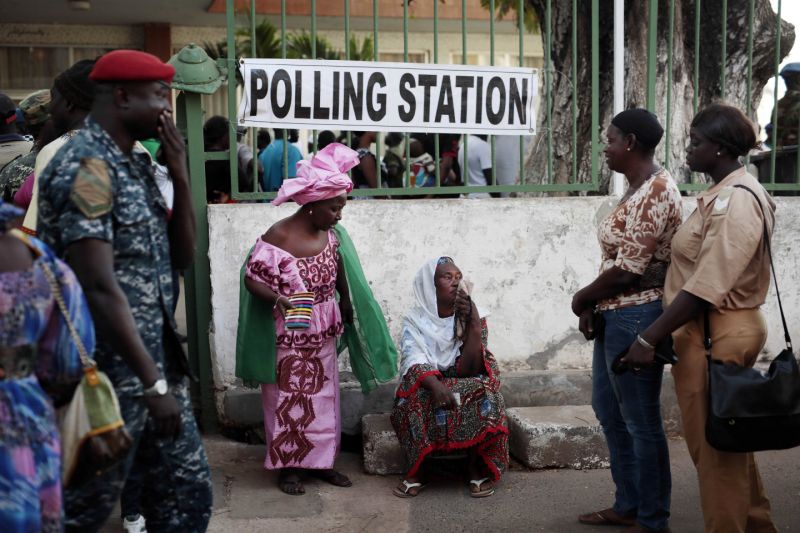
Mr Lopatka also clarified that the EU observation mission would not certify or validate the election results, saying that responsibility rested with the national authorities, particularly the Independent Electoral Commission.
The mission will assess the electoral process before election day, during voting and afterwards, before issuing its report and recommendations.
During his first visit to The Gambia as Chief Observer, Mr Lopatka said he had met the IEC, the Chief Justice, the Minister of Foreign Affairs, the National Human Rights Commission, political party representatives, journalists, civil society organisations, religious leaders and domestic election observers.
He is expected to return to the country in December to present the mission’s preliminary findings at a press conference two days after the election.
The EU has observed all national elections in The Gambia since 2016 and has supported reforms aimed at strengthening independent institutions, the rule of law and human rights.
By Adama Makasuba



Recent Comments