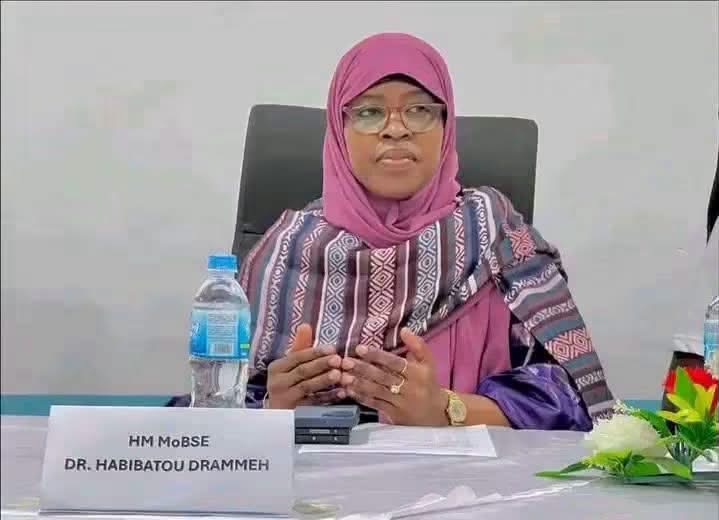
The Ministry of Basic and Secondary Education is set to roll out a new foundational learning programme in seven national languages, in a major move aimed at tackling language barriers affecting young learners in the early years of education.
The Structured Pedagogy Foundational Learning Programme will be introduced across all public Early Childhood Development centres and Lower Basic Schools during the academic year.
The ministry says the programme is designed to address the longstanding challenge of using English as the medium of instruction for children who are still developing basic literacy and numeracy skills.
“For years, English as the medium of instruction for early-grade learners in ECD and Grades 1–3 has been a learning barrier,” the ministry said, noting that many children struggle to understand classroom instructions because English is not commonly spoken at home or in their communities.
Under the programme, children will be taught in seven national languages: Mandinka, Pulaar, Wolof, Manjaku, Seereer, Jola and Soninke.
The ministry said the approach will allow children to learn “in a language they understand best”, making lessons more meaningful, inclusive and effective.
The programme will focus on improving foundational literacy and numeracy, with learners expected to develop key skills including letter recognition, sounding and blending, reading, writing and basic numeracy by the end of Grade 3.
MoBSE said the initiative is being implemented with support from Learning Masterminds, a Ghana-based NGO with expertise in foundational literacy and numeracy through structured pedagogy.
The programme is also supported by the World Bank under the Resilience, Inclusive, Skills and Equity Project, known as RISE.
The ministry said the initiative is expected to strengthen the foundation of learning for children across the country by ensuring that language does not become a barrier to acquiring essential skills during the critical early years of education.
By Adama Makasuba





Recent Comments