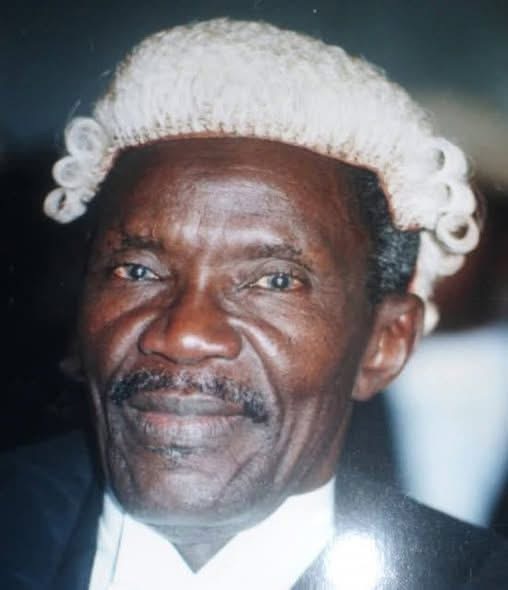
One year has passed since The Gambia lost one of its most incandescent minds, Lawyer Fafa Edirissa Mbai.
Time has moved, yet the wound remains tender, and the void he left still echoes across our legal, intellectual, and civic landscapes.
His passing was not the departure of an ordinary man; it was the fall of a baobab whose roots nourished generations and whose branches sheltered a nation’s conscience.
In remembering him today, Shakespeare’s immortal words return with renewed force: “When he shall die, take him and cut him out in little stars…” For indeed, Fafa’s brilliance continues to illuminate our collective sky—guiding, provoking, challenging, and inspiring.
Fafa Edirissa Mbai’s journey—from a village boy to one of the most formidable legal scholars in Senegambia—remains a testament to the transformative power of intellect, discipline, and courage.
A founding member of the prestigious Fana Fana Chambers, he served as Attorney General and Minister of Justice under both the PPP and the AFPRC.
Few Gambians have navigated such contrasting political terrains with integrity intact. His legal career was a tapestry of paradoxes: a radical Marxist thinker with conservative political instincts, a village traditionalist with cosmopolitan sophistication, a man of the people who debated with the rigor of a philosopher‑king. These contradictions did not diminish him—they made him singular.
His intellectual path ran parallel to that of his high school classmate and lifelong friend, the late Professor Lamin Sanneh of Yale and Harvard.
Together, they embodied the highest aspirations of Gambian scholarship—one shaping global conversations on law and justice, the other reshaping global understandings of religion, culture, and identity. Their friendship was a dialogue between two towering minds.
One year after Fafa’s passing, it is comforting to imagine their reunion—two brilliant sons of Senegambia resuming their eternal conversation.
Fafa’s literary works—Senegambian Insight and The Service of My Beliefs—remain indispensable texts for understanding the region’s history, identity formation, and colonial legacies. His writing was never ethnic chauvinism; it was cultural affirmation rooted in scholarship, humility, and truth. He wrote as a man who understood that identity is not a weapon but a mirror—reflecting who we are, where we come from, and what we must become.
Within the legal fraternity, Fafa was revered as an oracle of constitutional law. His appearances before the Court of Appeal and the Judicial Committee of the Privy Council set standards that shaped Gambian jurisprudence long before the establishment of the modern Supreme Court.
He was often compared to Lord Denning—not for mimicry, but for shared courage. Like Denning, he believed the law must serve the people, not imprison them. His arguments were not mere legal submissions; they were moral interventions.
History will vindicate Fafa’s service. Under the PPP, he established the Evaluation of Assets and Prevention of Corruption Commission—an early attempt to institutionalize accountability.
Under the AFPRC, he condemned human rights abuses and resisted injustice, even when silence would have been safer. His critics saw contradictions; those who understood him saw consistency—an unwavering loyalty to justice, truth, and the Republic.
A year after his passing, Fafa’s light remains undimmed. His life reminds us of John Donne’s eternal truth: “No man is an island.” Fafa was a bridge—between generations, between ideologies, between the past we inherited and the future we must build.
His legacy endures in the lawyers he mentored, the students he inspired, the institutions he strengthened, the ideas he defended, and the nation he loved with fierce devotion.
We owe him more than remembrance. We owe him fidelity to the values he embodied: justice without fear, integrity without compromise, scholarship without arrogance, and patriotism without theatrics. To honor Fafa is to continue the unfinished work of building a just, thoughtful, and principled Gambia.
As we mark one year since his transition, we do not mourn a life cut short; we celebrate a life well lived. A life of courage. A life of intellect. A life of service.
The baobab has fallen, but its shade remains. The star has set, but its light endures. The man is gone, but the legacy is immortal. May Allah grant Lawyer Fafa Edirissa Mbai eternal peace and the highest station in Jannah.
By Alagi Yorro Jallow








Recent Comments