Review By Alagi Yorro Jallow
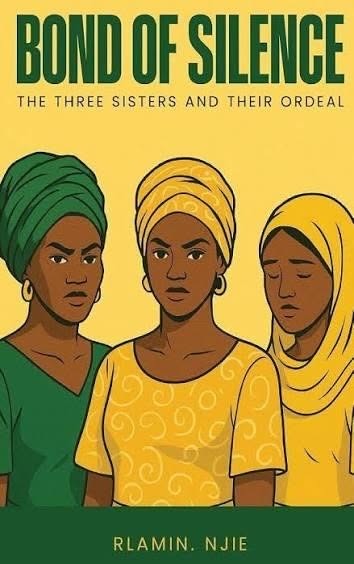
Some books arrive quietly, without commercial hype, yet carry the moral weight of a nation’s unspoken wounds. Rlamin Njie’s Bond of Silence: The Three Sisters and Their Ordeal, a 106-page hardcover published on April 24, 2026, by Columbus Book Publishers, is one such work.
It confronts one of the most painful violations inflicted upon women and girls across parts of Africa: Female Genital Mutilation (FGM). In its pages, silence becomes testimony, trauma becomes narrative, and three sisters embody a struggle that transcends geography and generation.
Njie’s work is not merely a novel; it is a cultural intervention. The author herself reached out to me personally, inviting me to the book launch in New York — a gesture that speaks to the seriousness with which she approaches the subject and the urgency she feels in bringing this story to public consciousness.
Though I could not attend because of an unforgiving schedule, the invitation underscored the book’s intention: to gather voices, break silence, and create a community of witnesses around a subject too often hidden behind cultural pride or political caution.
The power of Bond of Silence lies in its narrative architecture. Njie writes with restraint, refusing to sensationalise the sisters’ ordeal. Instead, she lets the horror of FGM emerge through memory, dialogue, and the protagonists’ fractured emotional landscapes.
The title’s silence is not metaphorical; it is the lived silence elders impose on girls, enforce through tradition, and perpetuate in communities that fear confronting their own complicity. Njie’s achievement is to transform that silence into narrative sound — a sound that echoes long after the final page.
The three sisters are not symbolic placeholders; they are fully realized characters whose pain, resilience, and longing give the book its human depth. Njie’s prose is attentive to the psychological aftermath of FGM: the shame that isolates, the bodily memory that haunts, the emotional distance that grows between siblings who shared the same ordeal but processed it differently.
In Njie’s hands, trauma is not a single event but a lifelong negotiation with identity. In this sense, Bond of Silence stands alongside works such as Mariama Bâ’s So Long a Letter, Tsitsi Dangarembga’s Nervous Conditions, and Nawal El Saadawi’s Woman at Point Zero — literature that exposes the intimate violence hidden beneath cultural norms.
Njie situates the sisters’ ordeal within a broader social landscape, revealing the complicity of institutions that allow FGM to persist. Religious authorities who refuse to condemn the practice, political leaders who fear losing rural support, and community elders who insist on preserving tradition even at the cost of bodily harm, all appear in the novel not as caricatures but as products of a system that prioritizes cultural continuity over human dignity.
Njie’s critique is sharp yet empathetic. She understands that FGM persists not because communities are cruel, but because societies are trapped in cycles of inherited belief, gendered power, and communal pressure.
One of the book’s most striking contributions is its exploration of intergenerational trauma. The sisters’ ordeal becomes a lens through which Njie examines how violence travels across time, how mothers who were cut often become defenders of the practice, how fathers remain silent out of fear of challenging tradition, and how daughters inherit both the physical scars and the emotional burdens of their mothers’ choices.
The “bond of silence” is thus not only imposed; it is inherited. Njie’s narrative reveals how trauma becomes tradition, how pain becomes ritual, and how silence becomes a cultural inheritance.
This insight is inseparable from the author’s literary identity. Rlamin Njie belongs to that emerging generation of African writers who understand literature not merely as art but as civic responsibility.
Her prose carries the weight of witness, not the distant witness of an academic researcher, but the intimate witness of a man who has lived close to the stories she tells. She writes with empathy, restraint, and a refusal to sensationalize suffering. Her engagement with the subject of FGM is not opportunistic; it is rooted in a long‑standing commitment to gender justice and community education.
Her decision to launch the book in New York, a global crossroads of diaspora activism and intellectual exchange, underscores her ambition to situate the conversation about FGM within both African and international frameworks.
Njie values dialogue, builds communities around her work, and understands that breaking silence requires collective engagement. In doing so, she positions herself as an important emerging voice in contemporary African literature—a writer whose courage matches her craft and whose commitment to justice gives her work enduring relevance.
The novel’s structure mirrors the way trauma disrupts memory. Njie moves fluidly between past and present, between the sisters’ childhood experiences and their adult attempts to reclaim agency. Her prose is lyrical without being sentimental, and her deliberate pacing gives the story room to breathe.
The alternating voices of the sisters converge into a collective testimony that indicts not only the act of FGM but the social machinery that sustains it.
Bond of Silence has profound political implications. At a time when African governments face increasing pressure to legislate against FGM, Njie’s book reminds us that laws alone cannot dismantle cultural silence.
Change requires narrative transformation, stories that humanise victims, challenge defenders of tradition, and expose the moral contradictions of societies that celebrate motherhood while mutilating girls.
Njie’s work is therefore not only literature; it is activism, advocacy, and a direct intervention in the global discourse on gender justice.
The book’s hardcover publication, modest in length but monumental in theme, signals a commitment to durability—a symbolic gesture for a story that demands permanence in public memory.
It belongs in university libraries, women’s rights organizations, diaspora community centers, and national reading lists. Its themes resonate far beyond the communities where FGM is practiced; they speak to universal questions of bodily autonomy, cultural inheritance, and the moral responsibility of societies to protect their most vulnerable members.
In the end, Bond of Silence: The Three Sisters and Their Ordeal is courageous in its subject matter, its storytelling, and its insistence that silence must be broken.
Rlamin Njie has written a book that confronts a painful reality with empathy, intelligence, and literary grace. It will disturb, enlighten, and inspire. It deserves to be widely read, openly discussed, and remembered long after its pages are closed.







Recent Comments