Gambian families are facing agonising uncertainty over loved ones feared to have died after a migrant boat believed to have departed the country was found drifting off Spain’s Canary Islands.
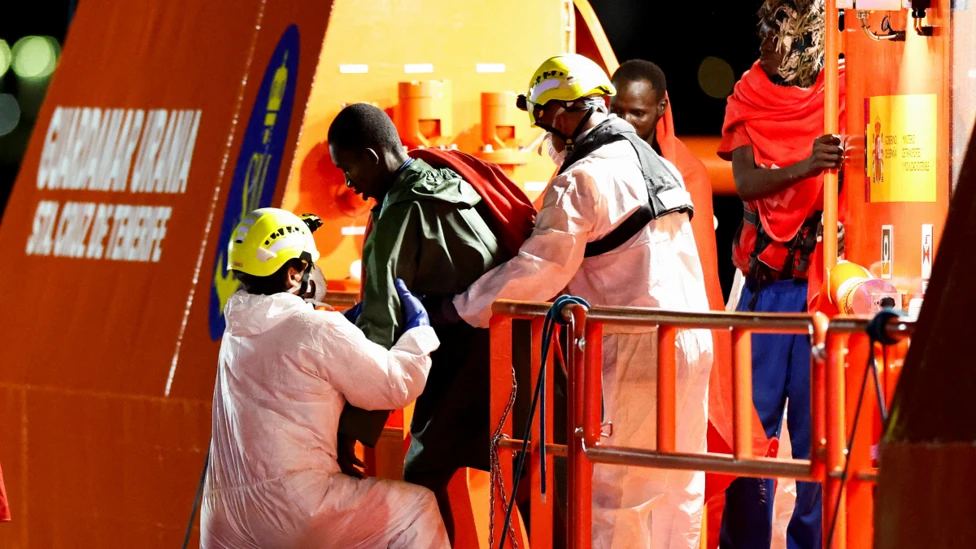
Spanish maritime rescue authorities rescued 44 people from the vessel and found five bodies on board after it was located south of Gran Canaria following weeks at sea.
Three of the survivors were reportedly taken to hospital in serious condition, while others arrived in a severely weakened state.
The Gambian government has now begun working with Spanish authorities to establish who was on board, their nationalities and what happened during the journey.
In a statement, the Ministry of Foreign Affairs, International Cooperation and Gambians Abroad expressed deep sadness over the incident and extended condolences to the families and loved ones of those who may have died.
It also expressed solidarity with families still waiting for information about relatives whose whereabouts remain unclear.
The ministry stressed that the identities and nationalities of the people reportedly on board had not yet been officially verified.
It said preliminary information suggested that the vessel may have departed from The Gambia, but warned against drawing conclusions before the relevant authorities establish the facts.
The uncertainty is particularly painful for families who may have spent weeks waiting for news from relatives who left the country by sea.
International reports indicate that the boat may have been at sea for about 27 days before it was located. Survivors reportedly endured severe dehydration and a prolonged shortage of food and water.
A Spanish migrant-rights organisation, Caminando Fronteras, has reported that as many as 83 people may have died during the journey, including women and a baby.
However, that figure has not been independently confirmed. Spanish rescue authorities have confirmed five bodies found aboard the vessel, while adverse sea conditions reportedly prevented their recovery.
The difference between the confirmed number of deaths and the much higher figure reported by the migrant-rights group underlines the challenge facing authorities as they try to establish the full human cost of the tragedy.
For the Gambian government, one of the immediate priorities is identifying those who survived and determining whether Gambian nationals were among those on board.
The Foreign Affairs Ministry said it was engaging Spanish authorities and other relevant stakeholders as part of efforts to verify the information.
It is also liaising through the National Focal Point under the Rabat Process, with the International Organization for Migration and the International Committee of the Red Cross to facilitate information-sharing and help clarify the circumstances.
The ministry urged the public and media to exercise caution over information that has not been verified, warning that inaccurate reports could cause further distress to families already dealing with uncertainty.
But behind the diplomatic efforts and official verification process are families waiting for one of the most difficult answers they may ever receive: whether their relatives survived the journey.
The tragedy has again exposed the human cost of dangerous migration across the Atlantic, where migrants undertake long sea journeys in vessels often ill-equipped for the conditions.
The Gambian government said it remained concerned about the dangers associated with irregular migration and the exploitation of vulnerable migrants.
It reaffirmed its commitment to working with partners to promote safer and regular migration pathways and to protect migrants from exploitation.
The ministry said it would provide further information once the facts have been established and verified.
By Adama Makasuba




Recent Comments