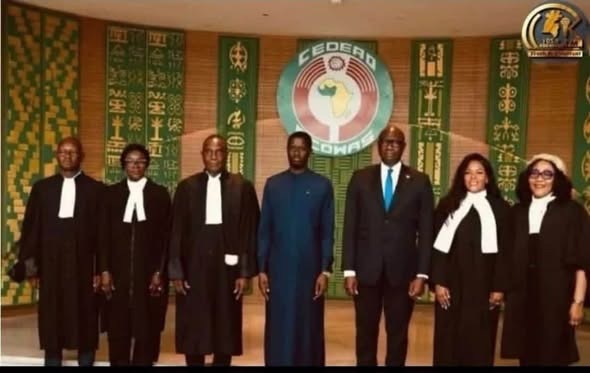
Justice Awa Bah’s appointment to the ECOWAS Community Court of Justice marks a historic first for The Gambia, extending a distinguished lineage of Gambian jurists who have served at continental and global levels, from Chief Justice Hassan B. Jallow’s tenure at the United Nations tribunals to Dr. Fatou Bensouda’s leadership at the International Criminal Court.
Her rise from the classrooms of Banjul to the regional bench in Abuja reflects a judicial career shaped by discipline, integrity, and the quiet authority of service.
Today, my Thursday tribute goes to Justice Awa Bah, the first Gambian judge to sit on the ECOWAS Community Court of Justice. This milestone carries both national pride and continental significance.
Her elevation is not an isolated triumph but part of a distinguished lineage of Gambian jurists who have served at the highest levels of continental and global justice, from Chief Justice Hassan B. Jallow’s tenure at the United Nations tribunals to Fatou Bensouda’s leadership at the International Criminal Court.
From the modest classrooms of Banjul to the solemn chambers of the Supreme Court, Justice Bah’s career has been defined by discipline, integrity, and an unwavering fidelity to the law.
As she takes her seat in Abuja, she joins a growing cadre of African women jurists reshaping regional justice, bringing a distinctly Gambian sensibility forged in transition, resilience, and hope. Her presence on the ECOWAS bench reminds us that Gambian jurists can rise to positions of continental authority without spectacle or theatrics, carrying only the dignity of service and the weight of their oath.
In the quiet architecture of Gambian public life, certain figures rise not through spectacle but through the slow, disciplined accumulation of trust. Justice Awa Bah is one of those figures. Her elevation to the ECOWAS Community Court of Justice for the 2026–2030 term marks a constitutional milestone for a small nation whose legal tradition has often been overshadowed by its political tempests.
For the first time in history, a Gambian judge will sit on the regional court that has become West Africa’s moral compass—and that judge is a woman whose career has been shaped by integrity, restraint, and the quiet dignity of judicial service.
Her story begins in Banjul, in the modest classrooms of Methodist Primary School and Gambia High School, where she laid the foundations of her intellectual discipline. She crossed borders early, studying law at the University of Abuja before being called to the Bar in both Nigeria and The Gambia in 1999.
Her return home marked the start of a public‑service career that took her through the Ministry of Justice, where she served as State Counsel, Principal State Counsel, and ultimately Solicitor General. During these years, the Gambian legal system was under strain, demanding not only technical mastery but moral steadiness.
Yet Justice Bah’s contribution to the Gambian judiciary cannot be measured solely by the judgments she delivered or the rulings she penned. In many ways, she became one of the quiet architects of the institution itself. Her role extended far beyond the bench: she shaped the Judiciary’s daily administration, from preparing the cause list to drafting its annual budget.
She oversaw the Gambia Judicial Training Institute, ensuring that judicial officers received the professional grounding required for a modern justice system. On numerous occasions, she acted in the Chief Justice’s stead when he traveled, representing the Judiciary at national conferences and safeguarding institutional continuity.
It would not be an exaggeration to say she was the principal architect behind the first‑ever successful hosting of the Commonwealth Judges and Magistrates Conference in The Gambia last year.
This landmark achievement showcased the country’s judicial maturity. Her career began at the Attorney General’s Chambers as Curator of Intestate Estates and later Deputy Solicitor General, then took her into the judiciary: she was appointed to the High Court in 2010, then to the Court of Appeal, where she became its president, and ultimately to the Supreme Court in 2020. She made it work by playing multiple roles—and playing them well.
Her ascent through the judiciary was earned, deliberate, and untainted by political theatrics. As a High Court judge, she presided over cases that tested the boundaries of state power and the vulnerabilities of ordinary citizens. She handled criminal matters involving sexual violence, property disputes that cut to the heart of family and inheritance, and state‑related litigation such as the assumption of Libyan assets—cases that required a judge who could balance statutory text with human consequence.
In October 2017, she became the first woman to serve as President of the Court of Appeal, a role that placed her at the center of appellate discipline. She insisted on procedural rigor, timely filings, and the principle that justice delayed is justice denied. Her leadership helped restore confidence in an institution that executive interference had at times overshadowed. Her judgments were marked by clarity, restraint, and fidelity to the record—qualities that would later define her tenure at the apex bench.
Three years later, in October 2020, she was elevated to the Supreme Court of The Gambia. Her arrival coincided with a period of national reckoning: constitutional reform debates, transitional justice processes and the slow rebuilding of judicial independence after decades of authoritarian rule.
She sat on matters that shaped Gambian jurisprudence, bringing to the Supreme Court a temperament marked by discipline, textual fidelity, and unwavering respect for the separation of powers. Now she steps onto the regional stage.
Over the past two decades, the ECOWAS Community Court of Justice has evolved into one of Africa’s most consequential human rights courts. It has ruled on arbitrary detention, electoral violence, digital rights, gender‑based violations and abuses of state power. It is a court where citizens, not only states, can seek redress. It translates West Africans’ lived realities into legal principles that bind governments. And on more than one occasion, it has held The Gambia itself accountable.
Justice Bah arrives at a moment when ECOWAS faces political fragmentation, democratic backsliding and regional insecurity. Her oath, administered in Abuja by President Bassirou Faye, commits her to impartiality, integrity, and protecting citizens’ rights across fifteen nations. She joins a bench that includes Désiré Henri Aihou of Benin, Charlyne M. Brumskine of Liberia, Henrietta Uzoamaka Didigu of Nigeria, and Dr Yaouza Ouro‑Sama of Togo, three women and two men, a composition that signals a new era of gender balance in regional judicial leadership.
Justice Awa Bah’s appointment places her in a lineage of African women jurists who have carried domestic experience into international arenas: Ghana’s Sophia Akuffo at the African Court on Human and Peoples’ Rights; Uganda’s Julia Sebutinde at the International Court of Justice; and The Gambia’s own Fatou Bensouda at the International Criminal Court.
Like them, Awa Bah brings a sensibility shaped by the legal struggles of a small nation, struggles over rule of law, impunity, constitutionalism and the fragile relationship between state and citizen.
Her jurisprudential style, measured, text‑anchored, attentive to both procedure and consequence, will serve her well in a court where the stakes are regional and the litigants diverse. She understands the tension between sovereignty and supranational oversight, having served in a country that has both invoked and been scrutinized by ECOWAS mechanisms.
She understands the moral weight of judicial independence, having worked through periods when Gambian judges were pressured, dismissed, or sidelined. And she understands the human dimension of rights, having presided over cases involving vulnerable victims and contested state action.
For Gambians, her elevation is a moment of pride. It signals that the country’s legal profession, often overshadowed by its political dramas, can produce jurists of regional caliber. It offers young Gambian women in law a living example that the path from classroom to Ministry, from High Court to Supreme Court, and from national bench to regional court is not closed to them.
For West Africa, her presence strengthens a court whose legitimacy rests on the quality of its decisions and the moral authority of its judges. President Faye’s charge to the new bench, urging them to let their oath guide them, resist pressure, and strengthen confidence in ECOWAS institutions, captures the responsibility now on her shoulders.
Justice Awa Bah goes to Abuja not as a celebrity jurist, but as a disciplined, quietly influential judge whose career has been built on service rather than spectacle. That, in itself, is her legacy: a Gambian woman who carried her nation’s dignity into the regional arena, and who now sits where the rights of millions of West Africans will be argued, defended, and ultimately protected.
Congratulations, Yetteh Bah.
By Alagi Yorro Jallow
REFERENCE:
- ECOWAS Authority of Heads of State and Government, Communiqué of the 69th Ordinary Session, Lungi, Sierra Leone, July 2026.
- ECOWAS Community Court of Justice, Official Statement on the Swearing‑In of Judges, Abuja, 2026.
- The Gambia Judiciary, Records of Appointment: High Court, Court of Appeal and Supreme Court (2017–2020).
- Ministry of Justice, The Gambia, Personnel and Service Records of Solicitor General and Legal Cadre (1999–2017).
- University of Abuja, Alumni Registry: LL.B (Hons) Graduates, Class of 1998.
- Nigerian Law School, Call to the Bar Records, 1999.
- African Court on Human and Peoples’ Rights, Biographical Notes on Justice Sophia Akuffo.
- International Court of Justice, Biographical Notes on Justice Julia Sebutinde.
- International Criminal Court, Biographical Notes on Fatou Bensouda.
- Regional Human Rights Jurisprudence, Selected ECOWAS Court Judgments (2001–2025).







Recent Comments