The Constitution of The Gambia envisages this country as a multiparty democracy. This is why Section 60 provides for political parties and their role in sponsoring candidates for public elections.
Although independent candidates and coalitions are also features of our elections, our system of governance rests on pluralism, through which citizens have an array of alternatives to choose from.
Pluralism is an essential part of democracy and governance. It gives expression to divergent and dissenting opinions, ensuring that no single voice, position, or entity is imposed on everyone, but that every opinion, position, and entity can be challenged. Ultimately, a pluralistic democracy safeguards the public interest against imposition, dictatorship, and manipulation, while creating the conditions for good governance to prevail.
In light of this, it is unfortunate that our democracy and governance face a growing incidence of political capitulation, as politicians and parties cross the carpet and form alliances. Every politician or party has the right to change affiliation or form an alliance. But when such decisions are driven purely by selfish interests, they become serious impediments to democracy and good governance.
This phenomenon becomes even more troubling when established opposition parties, movements and recognized politicians decide to join the ruling party and government. The opposition is as important as the government because it provides alternative perspectives and solutions and, above all, holds the government accountable. Democracy is stronger when strong opposition exists to become an effectively check on the incumbent.
Democracy and governance are therefore weakened when opposition politicians and parties capitulate to the ruling party and government. These politicians may claim they are forming alliances and produce grand agreements and memoranda of understanding. But I find their rationale unconvincing.
They have presented themselves as better alternatives to the NPP and President Barrow, yet the government has made no noticeable change or improvement to justify their decision to join it. Their capitulation therefore serves the interests of the incumbent government rather than the political alternatives they represented or, more importantly, the Gambian people.
For example, since the CA and Dr. Ismaila Ceesay joined the NPP in 2021, they have not made the government more transparent, efficient, or accountable, as they claimed they would. Instead, corruption, lawlessness, and inefficiency have increased. Essa Faal once condemned how the ‘Meet the People’ tour was conducted, yet he is now participating in what has become its largest and most wasteful edition.
How has his alliance with the NPP promoted the judicious use of public resources? It has not. We are recall how Mai Ahmad Fatty passionately wept for a draft 2020 draft constitution to pass which was killed by Barrow allies in parliament. What has GMC and Fatty achieved in making the NPP government deliver a true constitution since then?
Currently, about half of the country’s 27 registered political parties have aligned themselves with the ruling NPP. When parties and movements created to provide an alternative decide to jump onto the ruling party’s bandwagon, they help preserve the very status quo they previously condemned.
As opposition parties capitulate to a ruling party they previously criticized, they expose their dishonesty and insincerity. More seriously, they empower and enable that government by weakening the checks on its conduct.
If the NPP has not changed, these alliances offer no reason to expect the crisis of governance and development to improve. Instead, demands for accountability will diminish or even disappear. Corruption and waste, inefficiency and incompetence, abuse of power, disregard for the law and poor service delivery will persist.
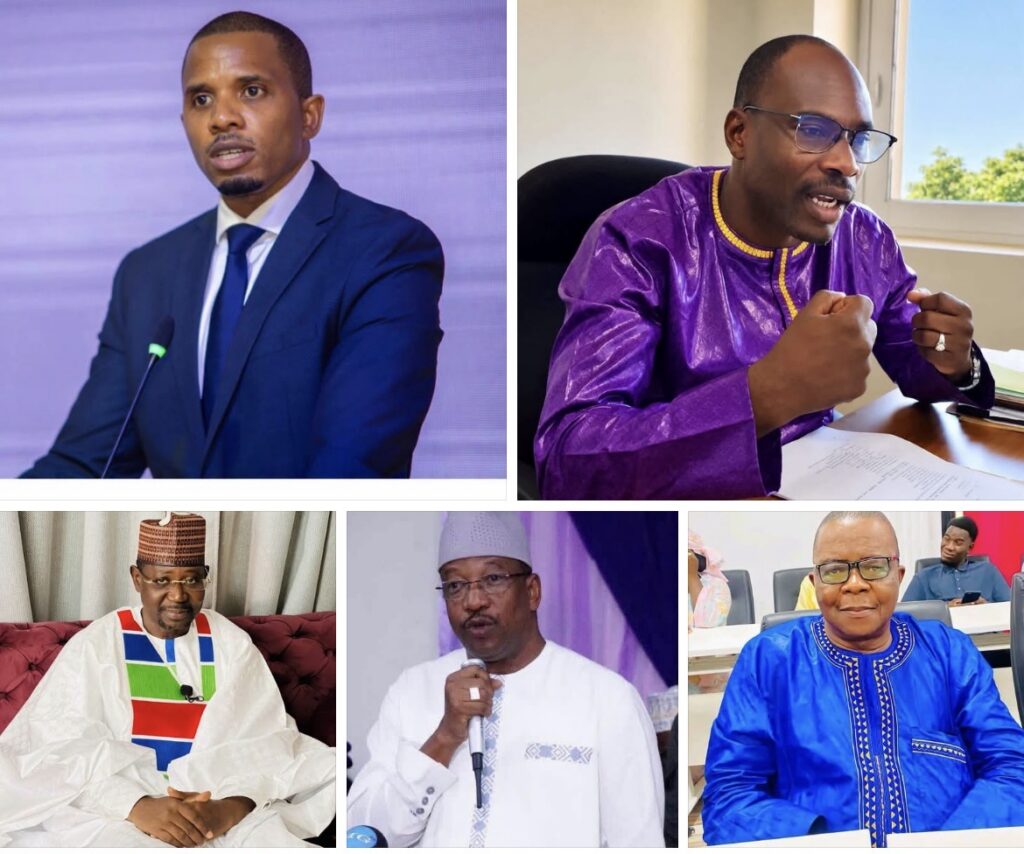
This is the harm that Prof. Sidat Yaffa, Essa Faal, Mamma Kandeh, Dr. Ismaila Ceesay, Mai Ahmad Fatty, and others, together with their parties, are inflicting on The Gambia. They are protecting and empowering a government they had rightly described as corrupt and inefficient. They are also enabling the emergence of a de facto one-party state or worse, propping up a dictatorship.
When viable opposition parties and influential politicians join the ruling party, they weaken the opposition and strip away effective political checks and demands for accountability. Transparency, accountability, the rule of law, human rights and efficient service delivery become the casualties.
That is a national tragedy. No To Third Term.
For The Gambia, Our Homeland.
By Madi Jorbateh







Recent Comments