
It is encouraging to see HIV receiving the attention it deserves in our national health discourse. While we celebrate achievements, we must remember that even one life lost to HIV is one too many. This is precisely why understanding our collective response and individual roles remains crucial for every Gambian.
Based on this comprehensive HIV monitoring report from Gambia’s National AIDS Secretariat, here’s the broader context that paints a picture of a country making significant strides in HIV prevention and treatment:
Historical Foundation and Evolution
Gambia’s HIV response began after the first case was diagnosed in May 1986, marking nearly four decades of sustained public health commitment. The country has dealt with both HIV-1 and HIV-2 serotypes, with HIV-1 being more virulent and prevalent.
Early Years (1990s-2000s)
Nationwide surveys in 1993-1995 among 29,670 pregnant women showed HIV-1 prevalence at 0.6% and HIV-2 at 1.1%, establishing Gambia as having one of the lowest prevalence rates in sub-Saharan Africa. After 15 years of surveillance, the epidemic remained at a low level, though with some regional variations.
Treatment Revolution (2010s)
In 2018, Gambia implemented WHO’s recommendation to provide all people living with HIV with lifelong antiretroviral therapy (ART) regardless of clinical status a major policy shift that expanded treatment access significantly.
Recent Progress (2015-2020)
New infections were cut by half and new infections among children were reduced by 75%, demonstrating the effectiveness of comprehensive prevention and treatment strategies.
Robust Testing Infrastructure
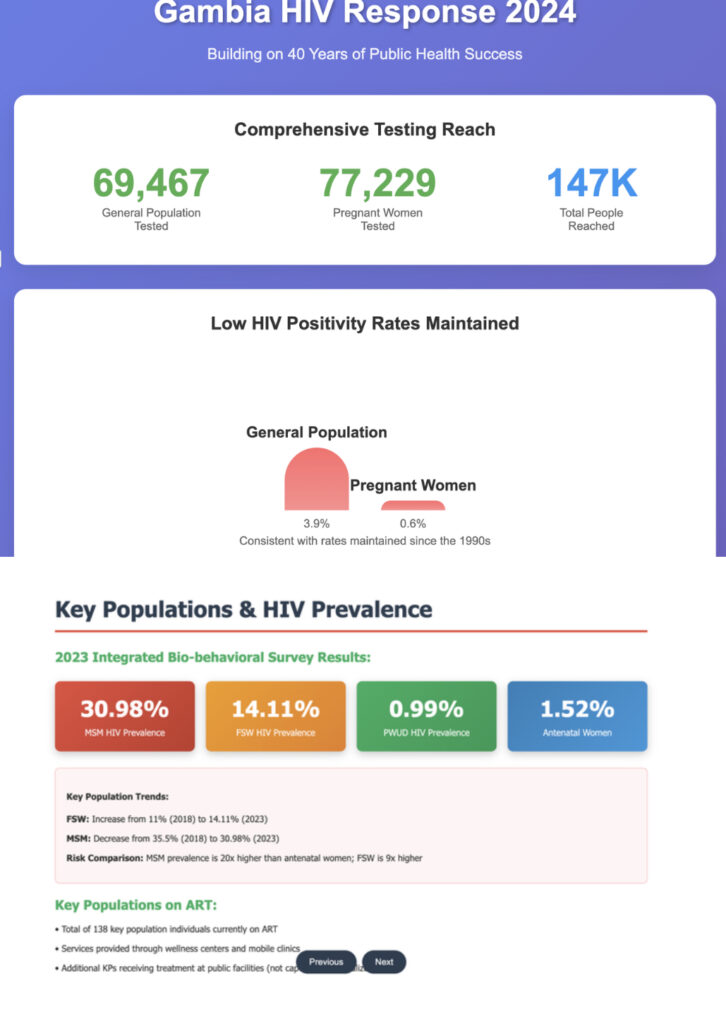
Gambia conducted extensive HIV testing in 2024, reaching nearly 150,000 people across the country:
- 69,467 people tested in the general population
- 77,229 pregnant women tested through prevention of mother-to-child transmission (PMTCT) programs
- Testing services available across all seven health regions
Current Prevalence Rates Remain Encouragingly Low
The 2024 data reveals consistently low HIV positivity rates maintained over decades:
- 3.9% positivity rate in general population testing (2,711 positive cases among 69,467 tested)
- 0.6% among pregnant women (461 positive cases among 77,229 tested) – remarkably similar to the 1993-1995 baseline
- These rates reflect both effective prevention efforts and the overall health status of the population
Strong Treatment Response with Low Mortality
Gambia has built a substantial HIV treatment program supported by Global Fund partnership through ActionAid and the National AIDS Secretariat:
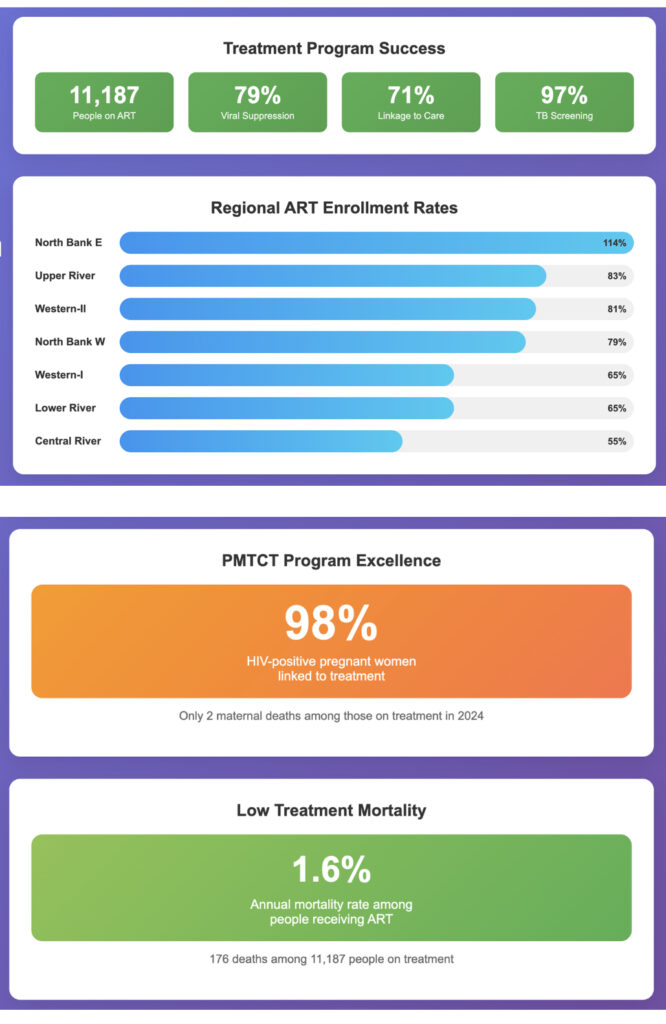
- 11,187 people currently receiving life-saving antiretroviral therapy (ART)
- 79% of people on treatment have achieved viral suppression, meaning they cannot transmit HIV to others
- 98% of HIV-positive pregnant women are successfully linked to care
- Low treatment mortality: Only 176 deaths among people on ART treatment in 2024, representing a mortality rate of approximately 1.6% among those receiving treatment
- Comprehensive TB screening (97% coverage) protecting people with HIV from co-infections
Innovation and Adaptation
The country adopted task shifting for HIV/AIDS—enabling nurses to dispense ART and capacitating community health workers to deliver a range of HIV services. During COVID-19 disruptions, multi-month dispensation of ARVs was initiated to maintain continued availability of treatment for all stable PLHIVs.
Prevention Success Stories
The PMTCT program shows particular strength:
- Over 77,000 pregnant women tested annually
- 98% treatment enrollment rate for HIV-positive mothers
- Strong infant monitoring with 91% receiving preventive treatment
- Only 2 deaths among PMTCT mothers on treatment in 2024
- Gambia was among 16 African nations in 2012 that “ensure[d] that more than three-quarters of pregnant women living with HIV receive antiretroviral medicine to prevent transmission to their child”
Building on Four Decades of Success
While celebrating these achievements, the data identifies opportunities to strengthen the response:
- Regional equity: Some areas like Central River Region need enhanced support to match the 95% treatment target
- Care completion: About 800 people who tested positive still need connection to treatment services
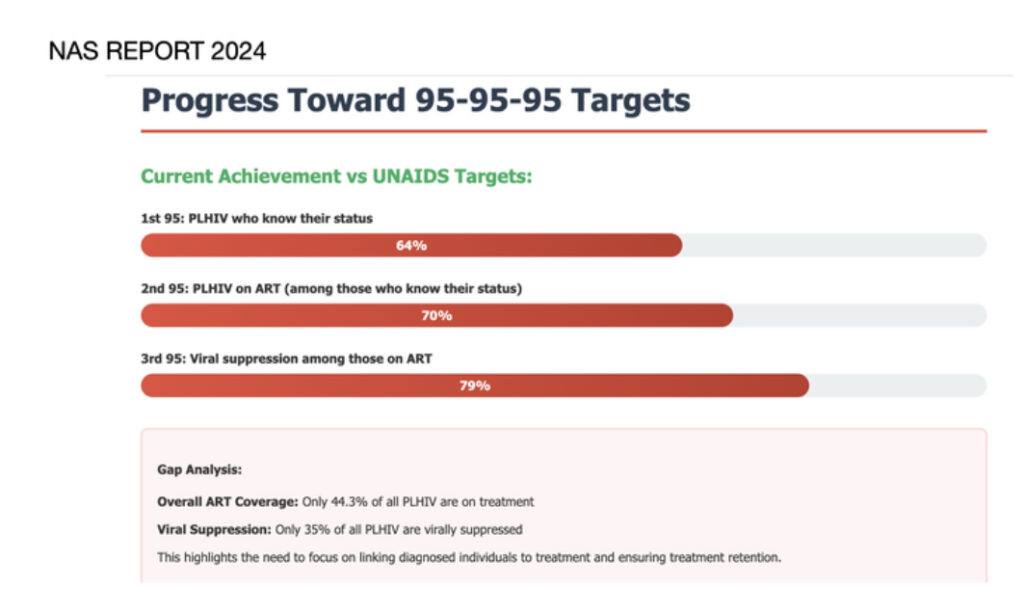
- Testing coverage: Despite increased outreach activities, testing coverage remains very low with only 64% the estimated PLHIV knowing their status in 2024.
A Call for Continued Partnership
This data demonstrates that Gambia has established strong health systems and committed leadership in HIV response over nearly 40 years. The path forward requires:
- Individual responsibility: Regular testing, especially for sexually active adults and pregnant women
- Community support: Reducing stigma and encouraging loved ones to know their HIV status
- Sustained investment: Maintaining funding for testing, treatment, and prevention programs
- Regional collaboration: Sharing successful practices between high-performing and emerging regions
The evidence shows Gambia is well-positioned to achieve the global goal of ending AIDS as a public health threat by 2030. This requires continued vigilance, not alarm – building on the solid foundation of nearly four decades of experience, testing infrastructure, treatment programs, and prevention services already in place.
The country’s consistent low prevalence rates since the 1990s, combined with current strong treatment outcomes and very low mortality rates among those receiving care, demonstrate that Gambia’s HIV response remains one of the most successful in West Africa.
By Ishmail Badgie
Founder and CEO of Innovarx Global Health Ltd
Sources
- National AIDS Secretariat, The Gambia. Monitoring & Evaluation GC7 Progress Report: January-December 2024. Ministry of Health, 2024.
- UNAIDS. “Five questions about the HIV response in the Gambia.” October 2021. Available at:https://www.unaids.org/en/resources/presscentre/featurestories/2021/october/five-questions-gambia
- UNAIDS. Country Profile: Gambia.Available at:https://www.unaids.org/en/regionscountries/countries/gambia
- Ritchie, H., Spooner, F., Roser, M. “HIV/AIDS.” Our World in Data, 2023. Available at:https://ourworldindata.org/hiv-aids
- Schim van der Loeff, M.F., et al. “Regional differences in HIV trends in The Gambia: results from sentinel surveillance among pregnant women.” AIDS, 2003; 17(12):1841-6.
- ActionAid The Gambia. “Global Fund Project: HIV&AIDS Response.” Available at:https://gambia.actionaid.org/our-projects/global-fund-project
- World Health Organization. “Consolidated guidelines on the use of antiretroviral drugs for treating and preventing HIV infection: recommendations for a public health approach.” 2nd edition, 2016.
- Joint United Nations Programme on HIV/AIDS. “Global HIV & AIDS statistics — Fact sheet 2024.” Available at:https://www.unaids.org/en/resources/fact-sheet
- Ministry of Health, The Gambia. National AIDS Strategic Plan 2020-2025.
- Global Burden of Disease Study 2021. “Global, regional, and national burden of HIV/AIDS, 1990–2021, and forecasts to 2050.” The Lancet HIV, 2024.





Recent Comments