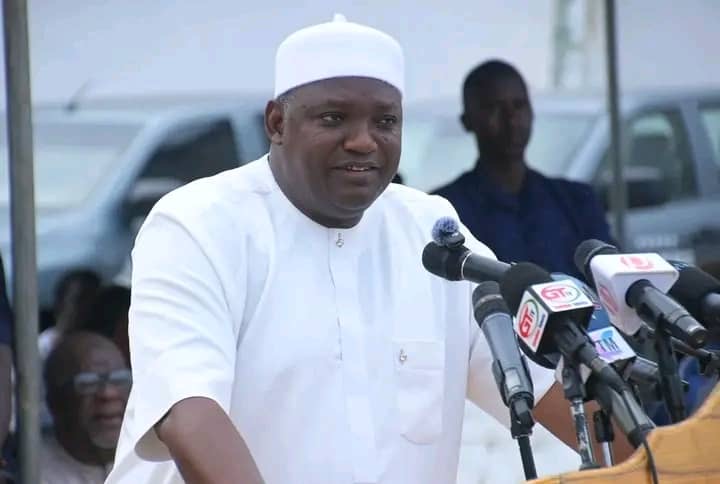
President Adama Barrow is predicted to win a third term in the December 5 presidential election, but the Economist Intelligence Unit (EIU) has forecast a sharply reduced victory margin.
The assessment is contained in the EIU’s special report, Two Year Forecast: Gambia, released recently by the London-based research and analysis organisation.
The EIU said Barrow’s popularity has declined and projected that his share of the vote would fall from the 53 per cent he secured in the 2021 presidential election.
It attributed the projected decline to what it described as undelivered promises on constitutional and security reforms, as well as limited economic opportunities, particularly for young people.
Despite this, the EIU said it expects Barrow to retain the presidency, citing the advantages of incumbency and the possibility of the president bringing smaller political parties into a coalition.
The organisation described the projected margin of victory as “wafer-thin”.
The EIU also highlighted the large number of undecided voters, saying local opinion polls from early 2026 indicated 34 per cent support for the National People’s Party (NPP), compared with 14.7 per cent for the United Democratic Party (UDP).
It said about 60 per cent of voters were either undecided or supporting independent candidates at the time of those polls.
According to the EIU, this leaves the race open, with undecided voters potentially shifting towards opposition forces if the parties succeed in forming a stronger coalition.
The report also examined attempts by opposition parties to unite ahead of the election.
It noted the formation of the UDP-led Gambia First Coalition and the emergence of Coalition 2026, led by the United Movement for Change and involving several political groupings.
The EIU identified opposition fragmentation as a central factor in its forecast, arguing that continued divisions could strengthen Barrow’s chances of securing another term.
However, it also acknowledged that the electoral picture could change if opposition parties succeed in consolidating their support.
The EIU said it draws on a global network of economists, industry specialists, policy analysts and consultants to produce political and economic research and forecasts.





Recent Comments