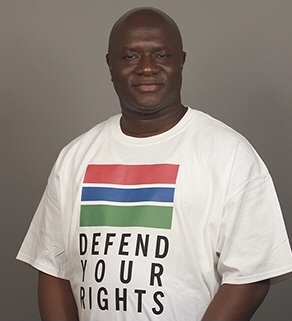
Madi Jobarteh, Executive Director of the Edward Francis Small Centre for Rights and Justice, has called for a radical change in how The Gambia approaches political transition, arguing that the country needs a temporary, non-partisan government focused solely on rebuilding its constitutional, legal and institutional foundations.
Jobarteh said he was opposed to both party-led and candidate-led political arrangements, arguing that such approaches could reproduce the political conditions that followed the 2016 election.
“I’m completely opposed to party-led or candidate-led,” he said, arguing instead for what he described as an agenda-led approach to system change.
According to Jobarteh, political parties should be prepared to put aside their individual interests and jointly identify a non-partisan technocrat with expertise in governance and public policy to lead a transitional administration.
He proposed that such a leader should be given a maximum of three years to implement a clearly defined programme of constitutional, legal and institutional reforms.
“What we need is therefore all the politicians, the political parties, be willing to sacrifice, to step up, and together we work to identify a non-partisan, a non-politician, a technocrat, expert who understands policy and governance,” he said.
Jobarteh said the proposed transitional leader should form a cabinet made up of experts rather than politicians, while political parties would focus on supporting the necessary legislative changes through the National Assembly.
He argued that the three-year period should be guided by a specific work plan aimed at establishing stronger systems of governance capable of preventing the country from returning to what he described as the weaknesses of the current political system.
“No politician will enter the cabinet,” he said, adding that the transitional administration should concentrate on legal and institutional reforms rather than partisan politics.
Jobarteh further proposed that once the reform process is completed and a new constitution comes into force, the transitional president and cabinet members should step aside and be barred from contesting the subsequent election.
He said political parties could then return to the normal electoral process and compete under the new constitutional framework.
“So we go back and the parties now move election and whoever wins should be it,” he said.
Jobarteh argued that the purpose of the proposed arrangement would not be to permanently replace the country’s democratic political system, but to create stronger foundations for it.
He said the transition should also include a major civic education programme to ensure that citizens understand their rights and responsibilities, as well as the powers and obligations of government.
For Jobarteh, the ultimate objective is to create a state with institutions strong enough to serve citizens regardless of which political party is in power.
He said The Gambia had been standing on what he described as “faulty grounds” since the COVID-19 pandemic and therefore needed a different approach to governance.
“I’m interested in salvaging this country,” he said, stressing that system change should take priority over individual political ambitions.
His proposal comes as political parties and political actors position themselves ahead of the 2026 presidential election, with negotiations over alliances, candidates and opposition cooperation continuing to dominate the political landscape.
By Adama Makasuba







Recent Comments