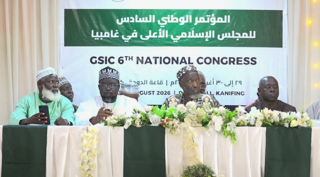
The Gambia Supreme Islamic Council on Sunday (30 August), opened its sixth National Congress, bringing together Islamic scholars, regional delegates, government officials and representatives of international organisations for a two-day gathering.
The congress is expected to review the performance of the outgoing executive and determine whether its mandate should be renewed or a new leadership elected.
Opening the congress, Supreme Islamic Council President Sheikh Essa Darboe reminded delegates that leadership of the Council is a trust and not a permanent entitlement.
He said the Council’s constitution requires its leadership mandate to be renewed every five years, making the congress an important opportunity for delegates to assess the work of the current executive and decide on the institution’s future leadership.
Sheikh Darboe thanked members of his executive, the wider Council and its development partners for their support and contributions during his tenure.
Representing the government, Ebrima Sisawo, Permanent Secretary at the Ministry of Lands, Regional Government and Religious Affairs, said the congress was taking place at a time when Gambian institutions were undergoing testing and rebuilding, while a younger generation was increasingly questioning how institutions function and the values they uphold.
Mr Sisawo said the government has a role in building roads, schools and other infrastructure and developing public policies, but argued that religious institutions have an equally important responsibility in shaping character and strengthening the moral foundations of Gambian society.
He called for closer cooperation between the government and religious institutions, saying that although both have different responsibilities, they share the broader objective of promoting the welfare and development of The Gambia and its people.
“I ask the scholars gathered here to continue teaching our people, especially our youth, that Islam is not a mere set of rituals but a complete way of encouraging honesty with power, wealth, land, and each other,” Sisawo said.
He added that the ministry would continue creating space for religious voices to contribute to national policymaking.
The two-day congress is expected to conclude with decisions on the future direction and leadership of the Gambia Supreme Islamic Council, one of the country’s key institutions representing the Islamic community.






Recent Comments